How do I design a simple planetary gear system?
- Share
- Issue Time
- Oct 6,2026
How do I design a simple planetary gear system?
Start by defining the input, output and fixed member, then select compatible sun, planet and ring tooth counts. For a simple unshifted spur planetary set, the ring tooth count equals the sun count plus twice the planet count. Check planet spacing, assembly phasing, interference and load capacity before designing the carrier, bearings, housing and lubrication. Tooth-count arithmetic alone does not validate a gearbox.
Define which member is held, driven and used as output
A simple planetary stage contains a sun, planets, an internal ring and a carrier supporting the planet pins. Its speed ratio depends on the chosen arrangement. With the ring fixed, sun input and carrier output, the ideal reduction ratio is 1 + zr / zs, where zr and zs are ring and sun tooth counts.
For example, a 24-tooth sun, 18-tooth planets and a 60-tooth ring give a 3.5:1 reduction in that arrangement. Changing the fixed member changes the ratio relationship.
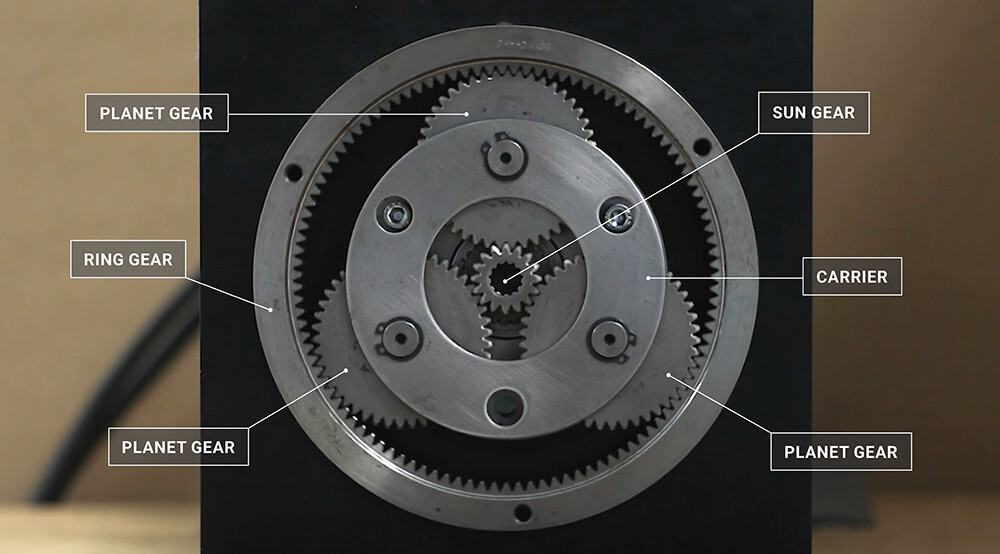
Check geometry and assembly together
For this standard unshifted spur layout, zr = zs + 2zp, with a common module and compatible pressure angle. For N identical, equally spaced planets, (zs + zr) / N must be an integer for assembly phasing. Adjacent planets also need tip clearance.
With three planets in the example, (24 + 60) / 3 = 28. The standard tip-clearance check is zp + 2 < (zs + zp) sin(180 degrees / N): 20 < 36.37. These preliminary checks do not replace interference, profile-shift or detailed mesh analysis.

Develop the load path and verification plan
Size teeth, planet pins, bearings, carrier and housing for the load spectrum and life target. Manufacturing errors and elastic deflection can make planet loads unequal; do not assume each planet carries exactly one third of the load merely because there are three.
The PairGears planetary-gear overview provides application context. Confirm backlash, alignment, lubrication, heat treatment and inspection requirements for the complete assembly before release.
