Why are spur gear ratios not always whole numbers?
- Share
- Issue Time
- Sep 27,2026
Why are spur gear ratios not always whole numbers?
A spur-gear ratio is a quotient of whole-number tooth counts, so the result does not have to be a whole number. A 20-tooth pinion driving a 47-tooth gear gives a 2.35:1 speed reduction. Designers choose feasible tooth counts to approach the required speed while meeting size and geometry constraints. A fractional ratio does not mean that either gear has fractional teeth.
Divide tooth counts in the stated direction
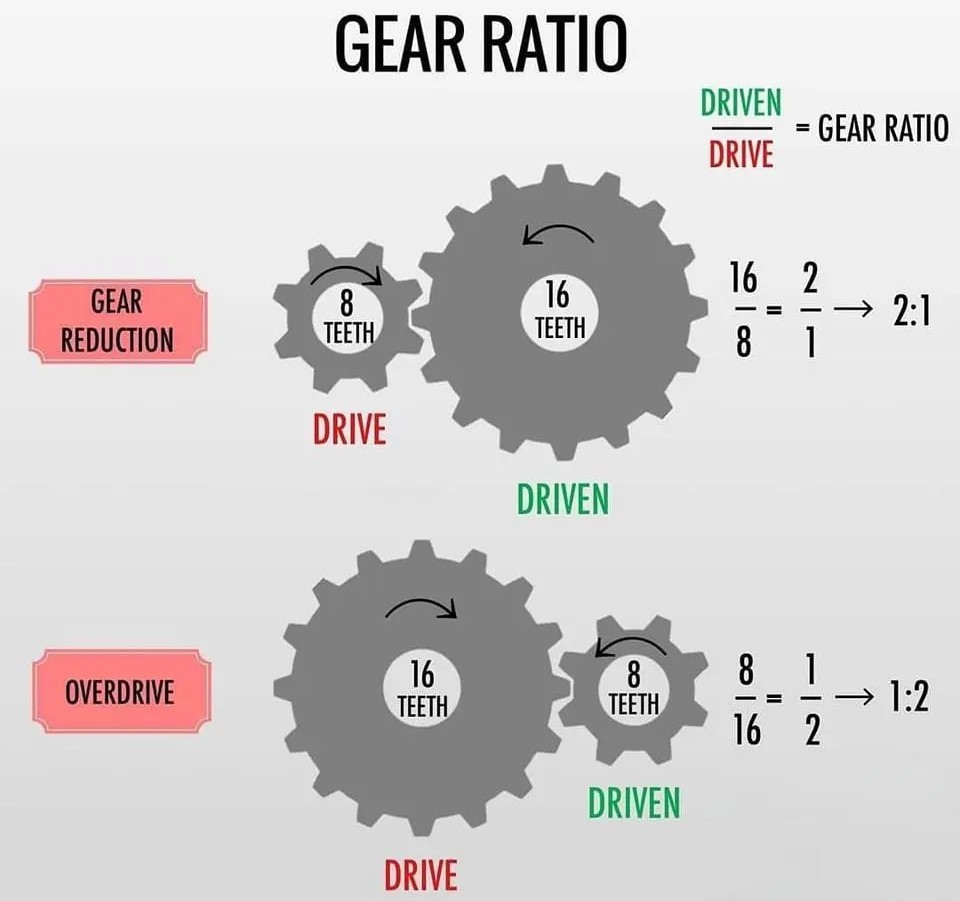
For a fixed-axis pair, define the reduction ratio as i = driven teeth / driving teeth = input speed / output speed. With 20 driving teeth, 47 driven teeth and 1,000 rpm input, output speed is 1,000 × 20 / 47, or approximately 425.53 rpm.
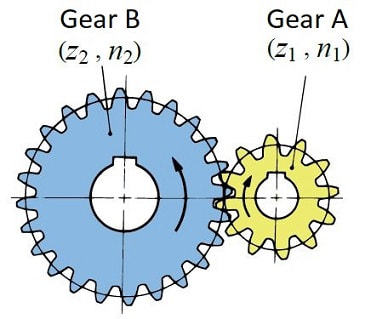
Two external gears rotate in opposite directions. If the driver and driven gear are exchanged, the speed relationship is inverted. The PairGears gear-ratio guide explains the basic convention.
Choose integers that fit the geometry
A target reduction of 2.35 can be obtained exactly with 47 and 20 teeth. A requested ratio may instead require an acceptable approximation, because the available tooth counts must also satisfy module, centre distance, tooth strength and interference constraints.
For standard unshifted spur gears, a = m × (z1 + z2) / 2. At module 2, the 20/47 pair has a theoretical reference centre distance of 67 mm. Profile-shifted designs require the corresponding operating-geometry calculation.
Keep the exact tooth counts in the specification
State both tooth counts, which shaft drives, and the allowable output-speed error. A rounded decimal such as 2.3 does not uniquely identify a gear pair. For a compound fixed-axis train, calculate each stage and multiply the stage ratios.
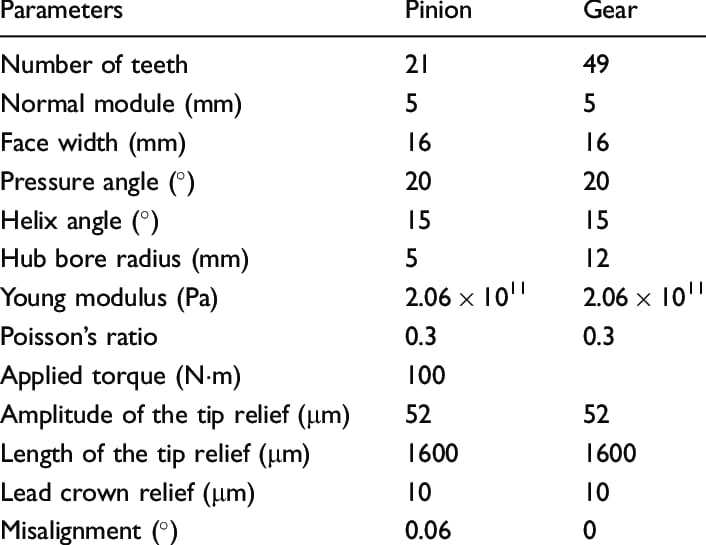
The illustrated parameter table uses a helical pair with 21 and 49 teeth: 49/21 is about 2.333. The tooth-count quotient also applies to a fixed-axis spur pair; the drawing must still specify the correct tooth system.