What Is a Planetary Gear Set and How Does It Work?
- Share
- publisher
- Jessica
- Issue Time
- Jul 4,2026
Summary
Learn what a planetary gear set is, how planetary gears work, key parts, types, advantages, applications, and custom gear project tips.
Introduction
Planetary gear is a common transmission structure used in many machines, vehicles, and drive systems. Compared with a simple gear pair, a planetary gear set can transmit torque through several gears at the same time, making the whole system more compact and capable of carrying higher loads.
For buyers, engineers, and maintenance teams, understanding how planetary gears work is useful before choosing a replacement part, reviewing a transmission design, or discussing a custom gear project with a supplier. A planetary gear set may look simple from the outside, but its actual performance depends on gear ratio, load sharing, backlash, material, heat treatment, accuracy, lubrication, and assembly conditions.
At PairGears, planetary gear-related projects are usually reviewed together with the real application. As a precision gear manufacturer and custom gear supplier, PairGears supports overseas buyers with custom gears, replacement gears, gear shafts, spline shafts, and transmission parts used in agricultural machinery, heavy-duty trucks, construction equipment, EV drive systems, and other mechanical equipment.
Quick Answer: What Is a Planetary Gear Set?
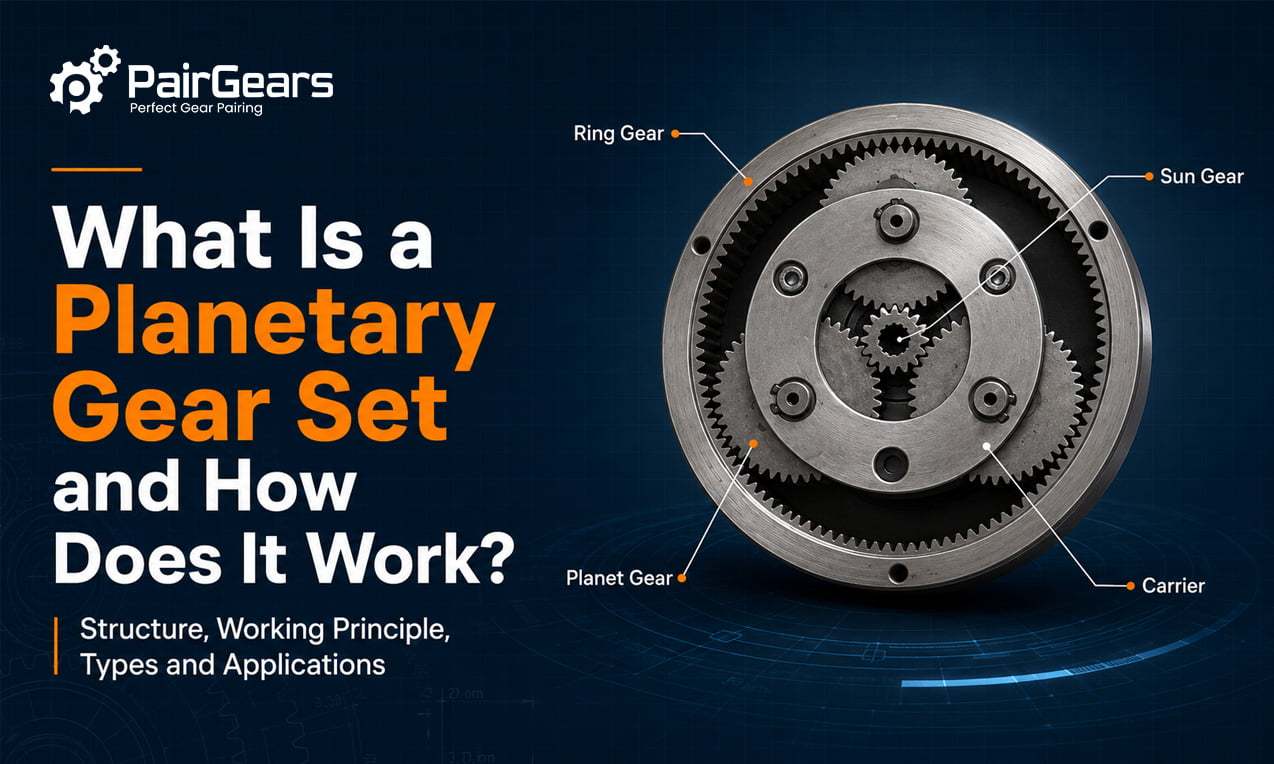
A planetary gear set is a compact gear system that usually includes a sun gear, several planet gears, a ring gear, and a planet carrier. The planet gears rotate around the sun gear while also rotating on their own axes, similar to planets moving around the sun.
This structure allows several gears to share the load at the same time. Because of this, planetary gears can provide high torque capacity, compact size, stable transmission, and flexible speed reduction or speed increase options.
Planetary gear sets are commonly used in gearboxes, automatic transmissions, EV drive systems, construction equipment, agricultural machinery, robotics, industrial reducers, and other applications where space, torque, and efficiency matter.
Planetary gear systems are also called epicyclic gearing systems in many technical references.
Main Parts of a Planetary Gear Set
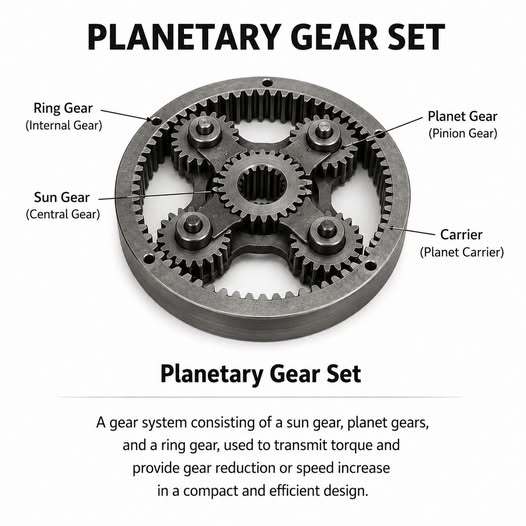
A standard planetary gear set usually has four main parts: the sun gear, planet gears, ring gear, and planet carrier. Each part has a different role, and the way these parts are fixed, driven, or used as output will change the final speed and torque.
| Component | Function | Why It Matters |
| Sun gear | The central gear in the system | Often works as the input gear or one of the main control elements |
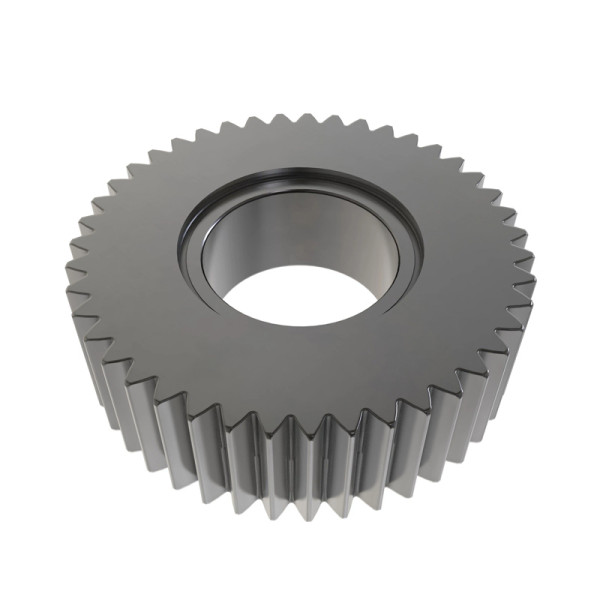
| Planet gears | Gears arranged around the sun gear | Share the load and rotate around the sun gear |
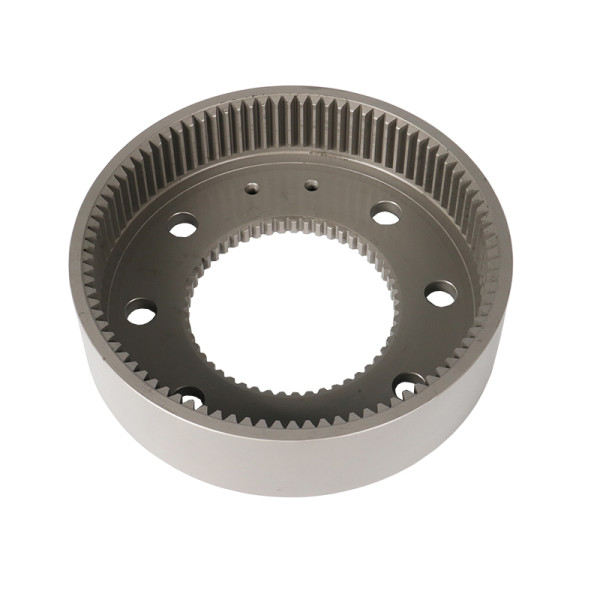
Ring gear | An outer gear with internal teeth | Works with the planet gears and can be fixed, input, or output |
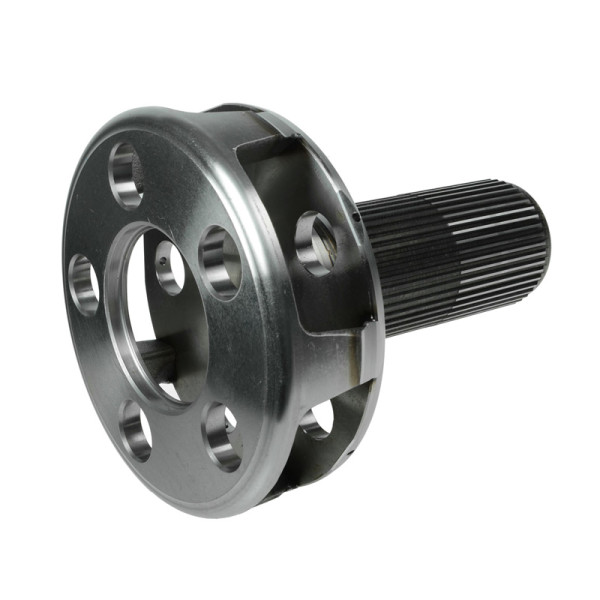
Planet carrier | Holds the planet gears in position | Often works as the output part in reduction systems |
The sun gear is located at the center. Around it, several planet gears mesh with both the sun gear and the internal teeth of the ring gear. The planet carrier keeps the planet gears evenly spaced and allows them to move around the sun gear.
This arrangement is different from a normal gear pair. In a simple gear pair, torque is mainly transmitted through one mesh point. In a planetary gear system, several planet gears can share the load, which helps improve torque capacity and compactness.
treatment plan, and inspection process.
How Does a Planetary Gear Work?
A planetary gear works by controlling three things: which part is used as the input, which part is fixed, and which part becomes the output.
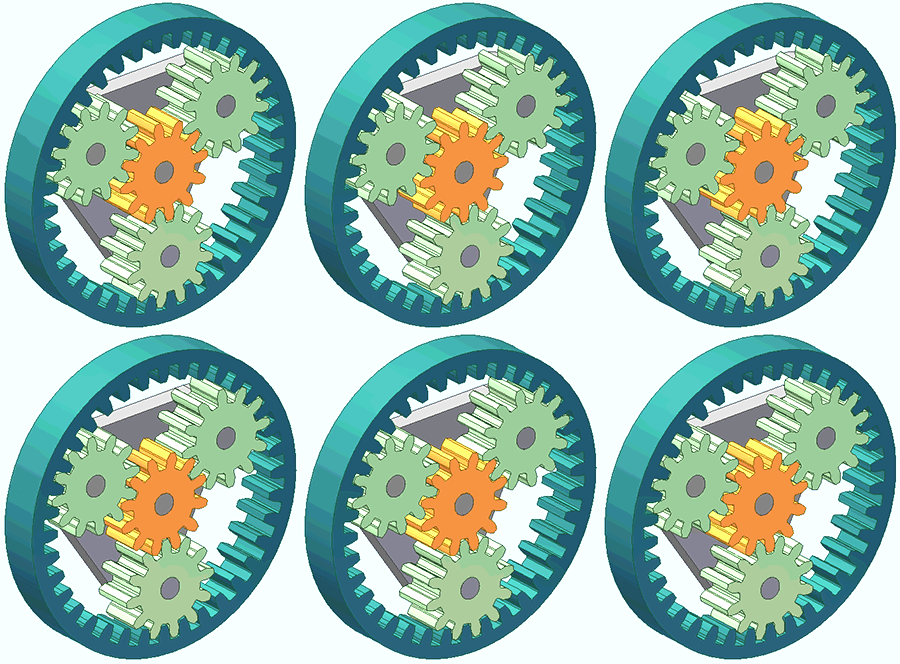
In many reduction systems, the sun gear is driven by the input shaft, the ring gear is fixed, and the planet carrier becomes the output. As the sun gear turns, it drives the planet gears. The planet gears rotate on their own axes and also move around the sun gear, causing the carrier to rotate at a lower speed but with higher torque.
Different working modes can create different results. For example, when the ring gear is fixed and the sun gear is used as input, the system usually works as a speed reducer. When the carrier is fixed, the system may create reverse rotation or a different speed relationship. When multiple planetary stages are combined, the gear system can achieve a higher reduction ratio in a compact space.
This is why planetary gears are widely used in compact transmission systems. By changing the fixed member and output member, engineers can achieve different speed ratios and torque outputs without making the gearbox very large.
Common Types of Planetary Gear Sets
Planetary gear sets can be designed in different ways depending on the required ratio, torque, space, and application.
A single-stage planetary gear set has one sun gear, one ring gear, one carrier, and one group of planet gears. It is often used when the required reduction ratio is not very high and the structure needs to stay simple. This type is common in compact reducers, small gearboxes, and applications where space and efficiency are important.
A two-stage planetary gear set combines two planetary stages. It can achieve a higher reduction ratio than a single-stage design while still keeping the structure relatively compact. This design is often used in equipment that needs higher torque output but does not have enough space for a large traditional gearbox.
A multi-stage planetary gear set uses several planetary stages together. It can achieve a much higher reduction ratio in limited space. However, more stages also mean more parts, more assembly requirements, and higher sensitivity to accuracy, lubrication, and load distribution. For custom projects, the supplier must review the full system instead of only checking one gear.
Key Parameters in a Planetary Gear Set
For buyers, it is not enough to know that a part is called a planetary gear. Several parameters will affect how the gear set works in real equipment.
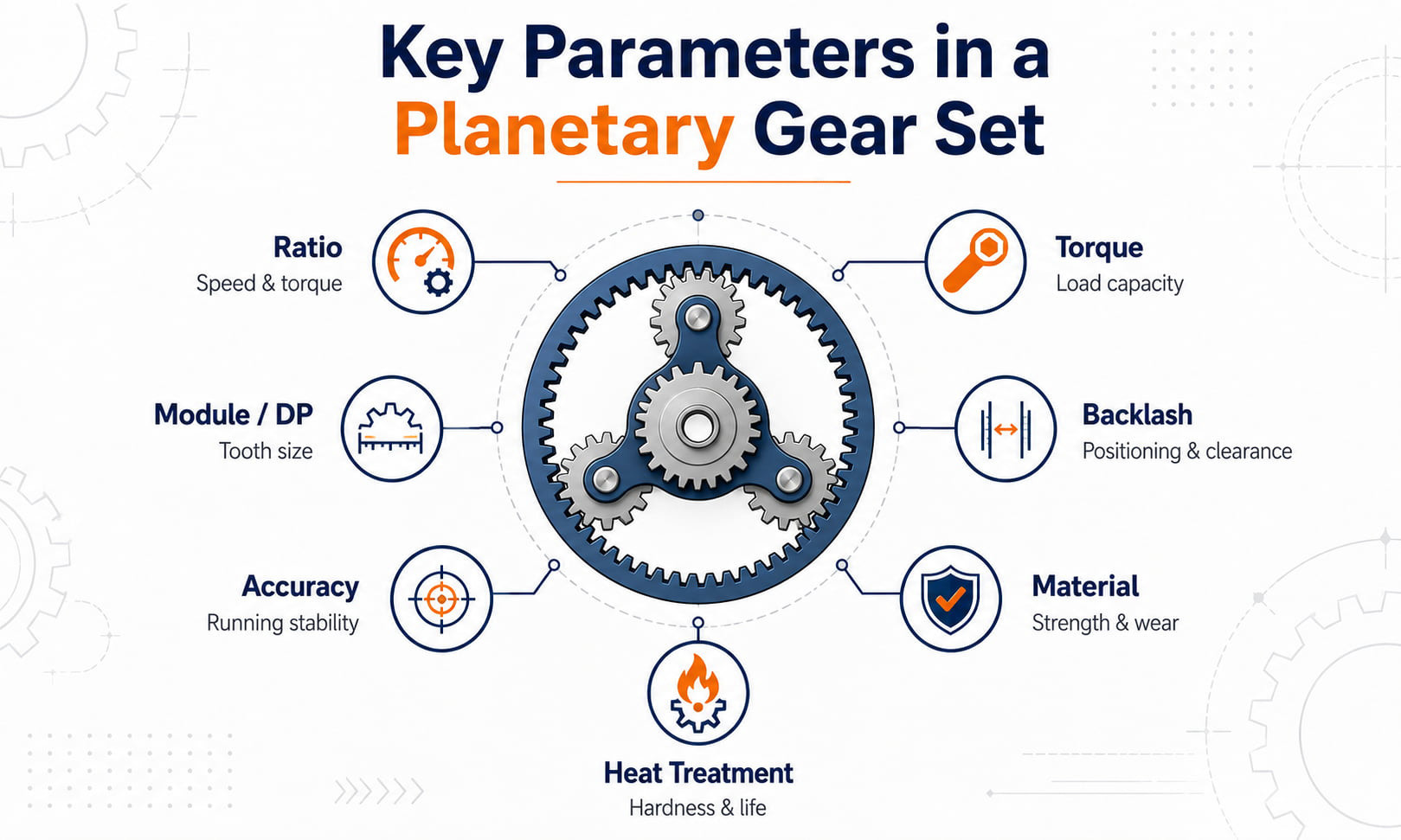
Gear ratio is one of the most important parameters. It determines how much the input speed is reduced or changed before reaching the output side. A higher reduction ratio usually means lower output speed and higher output torque.
Torque capacity is another key factor. Planetary gear sets are often chosen because they can carry high torque in a compact structure. However, the actual load capacity still depends on gear size, material, tooth design, heat treatment, lubrication, and how well the load is shared between the planet gears.
Backlash also matters, especially in systems that require accurate movement or stable reverse operation. Too much backlash may cause impact, noise, or poor positioning. Too little backlash may increase friction, heat, and assembly risk.
Material and heat treatment should not be ignored. Planetary gears often work under repeated load and compact space, so wear resistance, surface hardness, core strength, and distortion control must be considered together. Accuracy grade, module or DP, number of teeth, lubrication, and assembly condition can also affect service life and running stability.
For accuracy-related discussions, buyers may also refer to AGMA gear standards when defining inspection or accuracy requirements.
Advantages of Planetary Gears
Planetary gears are widely used because they offer several practical advantages.
First, they have a compact structure. A planetary gear set can provide a high reduction ratio in a smaller space. This is useful in EV drive units, compact reducers, robots, construction equipment, and other systems where gearbox size is limited.
Second, they can carry higher torque compared with many simple gear arrangements of similar size. Because several planet gears share the load, the system can transmit torque more evenly.
Third, planetary gear systems can offer good efficiency when designed and assembled properly. The compact layout and multiple contact points help the system work smoothly under suitable lubrication and alignment conditions.
Another advantage is ratio flexibility. By changing the number of teeth, the fixed member, or the number of stages, planetary gear systems can achieve different speed and torque outputs.
Planetary gears can also provide stable operation when the planet gears are balanced and the assembly accuracy is well controlled. This is important for applications that require long service life, smooth output, and reliable torque transmission.
Where Are Planetary Gears Used?
Planetary gears are used in many industries because they combine compact size, high torque capacity, and flexible ratio design.
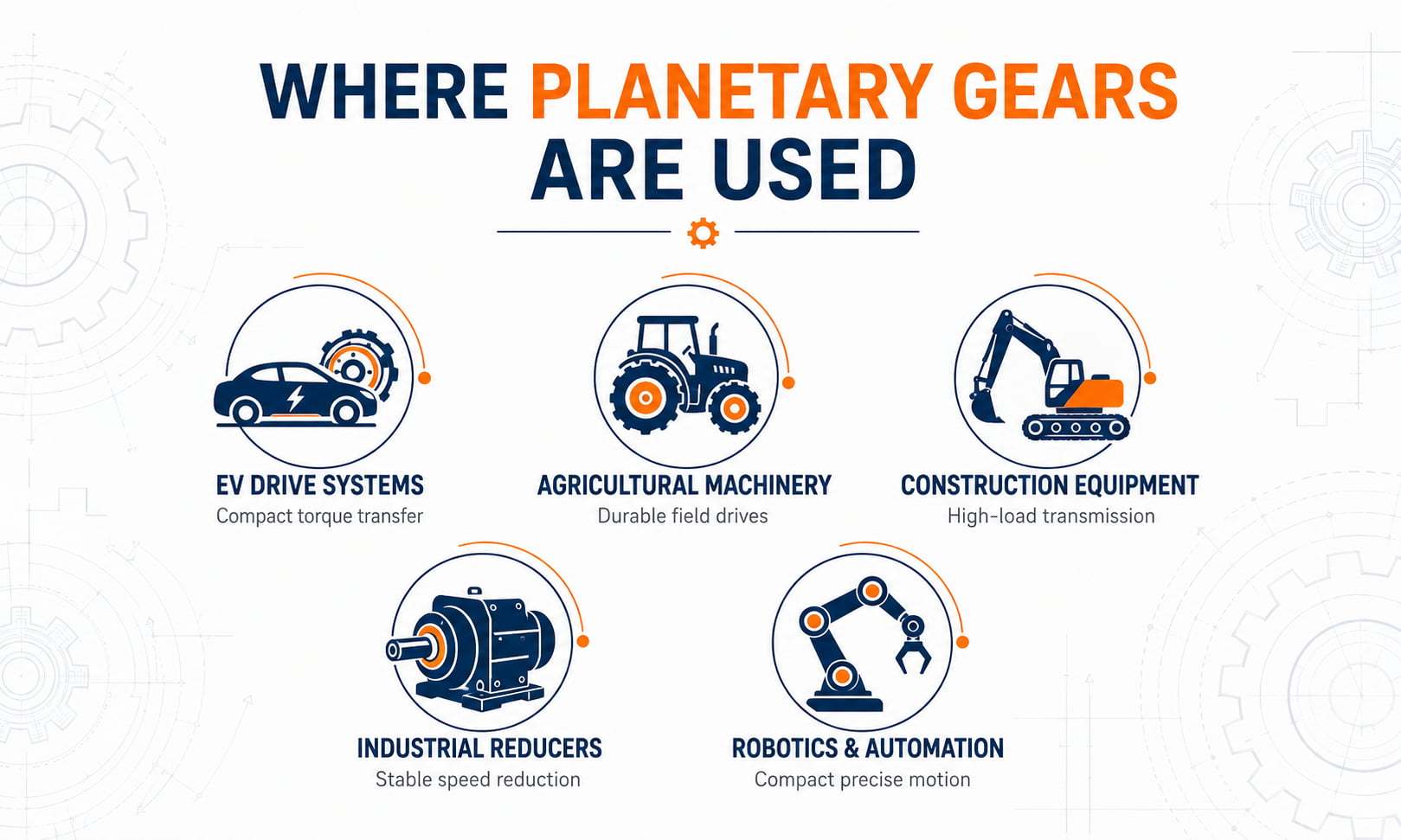
In EV drive systems, planetary gears can help reduce speed and increase torque while keeping the drivetrain compact. In agricultural machinery, they may be used in drive systems that need strength, durability, and stable torque transmission. In construction equipment, planetary gear systems are often used where high torque is needed in a limited space.
Planetary gears are also common in industrial reducers, robotics, automation equipment, wind power systems, power tools, and other machinery. In these applications, they help control speed, increase torque, improve transmission stability, or save space.
For heavy-duty applications, the supplier must pay attention to material, heat treatment, lubrication, tooth contact, and load distribution. For precision applications, backlash, accuracy grade, assembly condition, and running smoothness become more important.
Planetary Gear Set vs Ordinary Gear Set
A planetary gear set is different from an ordinary gear set in both structure and performance.
| Comparison Point | Planetary Gear Set | Ordinary Gear Set |
| Structure | Sun gear, planet gears, ring gear, carrier | Usually two or more external gears |
| Load sharing | Multiple planet gears can share load | Load is usually carried by fewer mesh points |
| Size | More compact for some ratios | May need more space for the same reduction |
Torque capacity | Higher torque capacity in compact layout | Depends on gear size and arrangement |
Ratio flexibility | Can use different fixed, input, and output members | Usually simpler ratio design |
Assembly requirement | More sensitive to alignment and accuracy | Usually easier to assemble |
Cost | May be higher due to more parts and precision needs | Often simpler and lower cost |
Planetary gear sets are not always better than ordinary gear sets. They are useful when compact size, torque density, ratio flexibility, and load sharing are important. For simpler applications, an ordinary spur gear or helical gear set may still be more practical.
How PairGears Supports Planetary Gear Projects
PairGears supports custom gear and replacement gear projects for overseas buyers. For planetary gear-related projects, the key point is not only producing one gear. The supplier needs to understand how the gear works inside the system.
In a planetary gear set, the sun gear, planet gears, ring gear, and carrier must work together. If one part has incorrect tooth geometry, material, hardness, backlash, or assembly condition, the whole system may be affected.
For custom planetary gear projects, PairGears can review drawings, samples, OEM reference numbers, gear photos, material, heat treatment, accuracy grade, and application requirements before production. This helps buyers confirm whether the project is suitable for sample development, replacement production, or batch manufacturing.
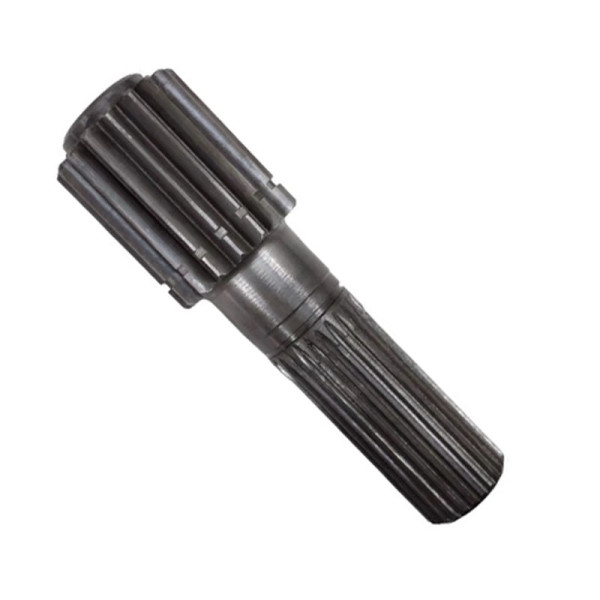
PairGears can support projects involving planetary gears, gear shafts, spline shafts, ring gears, transmission gears, replacement gears, custom precision gears, and small or medium batch gear projects.
For buyers, the goal is not only to find a planetary gear manufacturer, but to find a supplier that can understand the real working condition and help reduce production risk before the project starts.
FAQ
What is a planetary gear?
A planetary gear is part of a gear system where planet gears rotate around a central sun gear. The system usually also includes a ring gear and a planet carrier. It is used to transmit torque, change speed, and keep the transmission compact.
What is a planetary gear set?
A planetary gear set is a complete gear arrangement made of a sun gear, planet gears, a ring gear, and a planet carrier. Different parts can be used as input, output, or fixed elements to create different speed ratios and torque outputs.
How does a planetary gear work?
A planetary gear works by allowing the planet gears to rotate around the sun gear while also rotating on their own axes. Depending on which part is fixed and which part is used as output, the gear set can reduce speed, increase torque, or change rotation direction.
Why are planetary gears used in transmissions?
Planetary gears are used in transmissions because they can provide high torque capacity, compact structure, smooth power transfer, and flexible ratio design. They are common in vehicle transmissions, industrial reducers, EV drive systems, and heavy equipment.
Are planetary gears suitable for custom projects?
Yes. Planetary gears can be customized based on drawings, samples, material requirements, heat treatment, accuracy grade, and application needs. However, because the parts must work together as a system, the supplier should review the mating relationship and assembly condition before production.
Conclusion
A planetary gear set is a compact and efficient gear system that uses a sun gear, planet gears, a ring gear, and a planet carrier to transmit torque and control speed. Its main advantages include compact size, high torque capacity, load sharing, and flexible ratio design.
For buyers, understanding planetary gears helps when reviewing a transmission system, replacing worn parts, or starting a custom gear project. The key is not only knowing what a planetary gear is, but also understanding the structure, working mode, key parameters, and application requirements.
If your project involves planetary gears, gear shafts, spline shafts, ring gears, or other transmission parts, PairGears can review your drawings, samples, OEM reference numbers, photos, and application details before quotation.