What Causes Gear Noise? 8 Issues Buyers Should Check
- Share
- publisher
- Jessica
- Issue Time
- Jul 23,2026
Summary
Learn what causes gear noise and what buyers should check before ordering replacement gears, including wear, backlash, alignment and lubrication.
Gear noise does not always mean the gear itself has a problem. Wear, backlash, contact pattern, accuracy, assembly, bearings, lubrication, or even mismatched replacement gear specifications can all cause abnormal noise in a transmission system.
For buyers, the first step is not to decide immediately whether the gear should be replaced. It is better to organize the noise condition and the available project information first. As a custom gear supplier, PairGears reviews drawings, samples, photos, mating gear details, and application conditions before judging whether the project is ready for quotation, sample measurement, prototyping, or further technical confirmation.
Quick Answer: What Usually Causes Gear Noise?
Gear noise usually comes from tooth wear, pitting, wrong backlash, poor contact pattern, gear accuracy problems, shaft or bearing misalignment, lubrication issues, or incorrect replacement gear specifications. Buyers should not judge the gear from noise alone. Photos, drawings, mating gear information, operating conditions, and inspection results are often needed before quotation or replacement review.
Why Gear Noise Matters Before Ordering Replacement Gears
Gear noise is more like a signal than a single cause. When the sound becomes louder, it may come from tooth surface wear, or it may come from the mating part, assembly position, bearing condition, lubrication condition, or the wrong replacement specification.
If only one gear is replaced without checking the mating gear, backlash, contact pattern, installation position, and bearing condition, the noise may still remain. In some cases, the new gear may be blamed as a quality problem, while the real cause is a worn mating part, unstable assembly condition, or incomplete confirmation of the original parameters.
For replacement gear projects, buyers are advised to provide photos of the old part, equipment model, installation position, mating gear information, noise condition, and failure signs. The more complete the information is, the easier it is for the supplier to judge the next step.
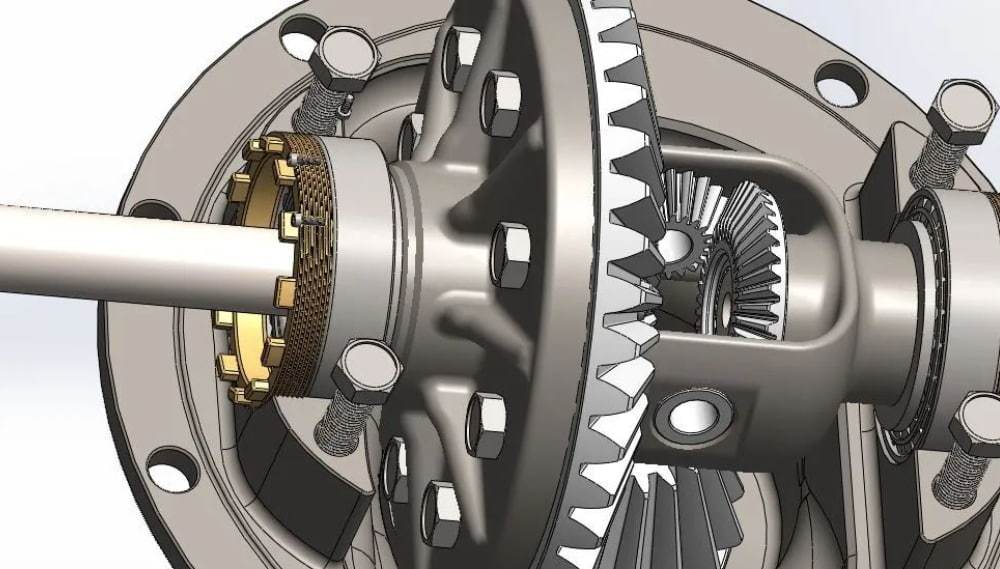
8 Issues That Can Cause Gear Noise
| Issue Buyers Should Check | What It May Mean |
|---|---|
| Tooth wear or pitting | Tooth surface wear, pitting, or peeling can affect smooth meshing. |
| Wrong backlash | Backlash that is too large or too small may cause impact noise, poor meshing, or heat. |
| Poor contact pattern | A shifted contact area may indicate problems with pairing, mounting distance, or tooth surface condition. |
| Gear accuracy or profile error | Tooth profile, lead, runout, or pitch errors may cause periodic noise. |
| Misalignment during assembly | Misaligned shafts or installation deviation can affect the meshing relationship. |
| Bearing or shaft runout problems | Worn bearings, shaft runout, or unstable support can transfer vibration to the gear. |
| Lubrication issues | Insufficient lubrication, unsuitable oil, or contamination can increase friction and noise. |
| Wrong replacement gear specifications | Different tooth count, module, DP, pressure angle, helix angle, or pairing relationship can cause mismatch. |
Key Areas Buyers Should Check
Tooth Wear and Surface Damage
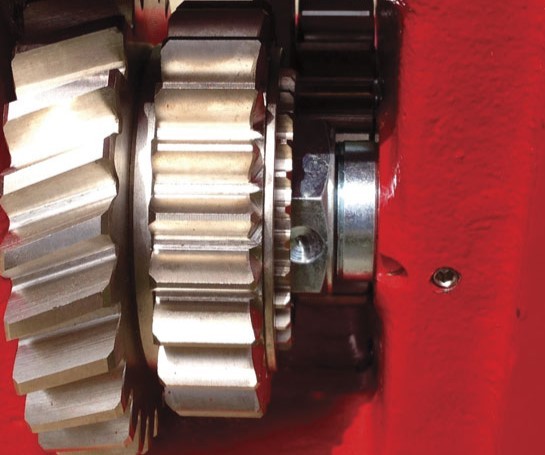
After long-term operation, an old gear may show polished areas, pitting, peeling, scratches, chipped edges, or local dents on the tooth surface. These changes can damage the original contact condition and cause impact, friction, or unstable noise during meshing.
Buyers should take clear close-up photos of the tooth surface, especially areas with wear, broken teeth, pitting, black marks, or abnormal shiny surfaces. If the old part is already heavily worn, it should not be copied only by its current appearance, because the worn dimensions and tooth surface condition may already differ from the original design. Buyers can also review how a worn gear can affect machine performance before confirming a replacement order.
Backlash, Contact Pattern and Accuracy
Backlash, contact pattern, and gear accuracy can all affect noise. Backlash that is too small may cause tight meshing, heat, or whining noise. Backlash that is too large may cause knocking noise during reversing or load changes.
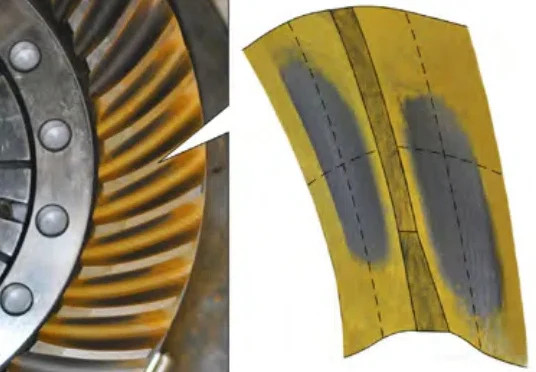
When the contact pattern shifts toward the tooth top, tooth root, tooth end, or one side, it often means that the installation position, pairing relationship, or machining accuracy needs to be checked. For paired projects such as bevel gears, ring gears, and pinions, buyers should provide mating gear photos and assembly information whenever possible. For gear pairs, the gear and pinion matching relationship should not be ignored.
Assembly, Bearings and Lubrication
Gear noise does not always come from machining. Eccentric assembly, non-parallel shafts, worn bearings, shaft runout, insufficient support rigidity, or housing deformation can all cause abnormal noise during actual operation.
Insufficient lubrication, unsuitable oil, contaminated oil, or high operating temperature can also increase friction, wear, and noise. If the tooth surface shows black marks, burning, abnormal shine, or scratches, the lubrication condition should also be checked.
Wrong Replacement Gear Specifications
A replacement gear may look similar from the outside, but that does not mean it can mesh correctly. Tooth count, module, DP, pressure angle, helix angle, tooth width, bore, spline, mounting distance, or pairing relationship can all create noise or mismatch risk if one detail is different.
An OEM number can be used as an identification reference, but it cannot replace drawings, sample measurement, or technical confirmation. OEM part numbers are used only for identification reference and do not imply official authorization or original brand affiliation.
Buyer Checklist: What to Check Before Sending an RFQ
| What Buyers Should Provide | Why It Helps |
|---|---|
| Gear photos | Shows tooth wear, bore, spline, markings, and visible damage. |
| Mating gear photos | Helps review pairing and meshing relationship. |
| Drawing or old sample | Supports measurement, quotation, and manufacturing review. |
| OEM part number | Useful as a reference, but not enough alone. |
| Noise condition | Shows when and how the noise appears. |
| Equipment model | Helps understand the application position. |
| Lubrication and working condition | Helps judge wear and operating risk. |
| Inspection requirements | Confirms whether reports are needed before shipment. |
| Quantity and target delivery date | Helps plan quotation, sampling, and production. |
What Photos and Information Should Buyers Provide?
The photos do not need to look like product promotion images, but they must be clear and complete. Buyers are advised to provide front and back views of the gear, tooth surface close-ups, bore, spline or keyway, OEM number or marking, mating gear, installation position, and a caliper or ruler reference for size. For a more detailed photo checklist, buyers can review what photos are needed to identify an OEM replacement gear.
Besides photos, buyers should also explain when the noise appears. For example, does the noise appear immediately after the new gear is installed, or does it become louder after the old gear has been used for some time? Does it appear at low speed, high speed, heavy load, reversing, or after continuous operation? This information is very helpful for judging the possible cause.
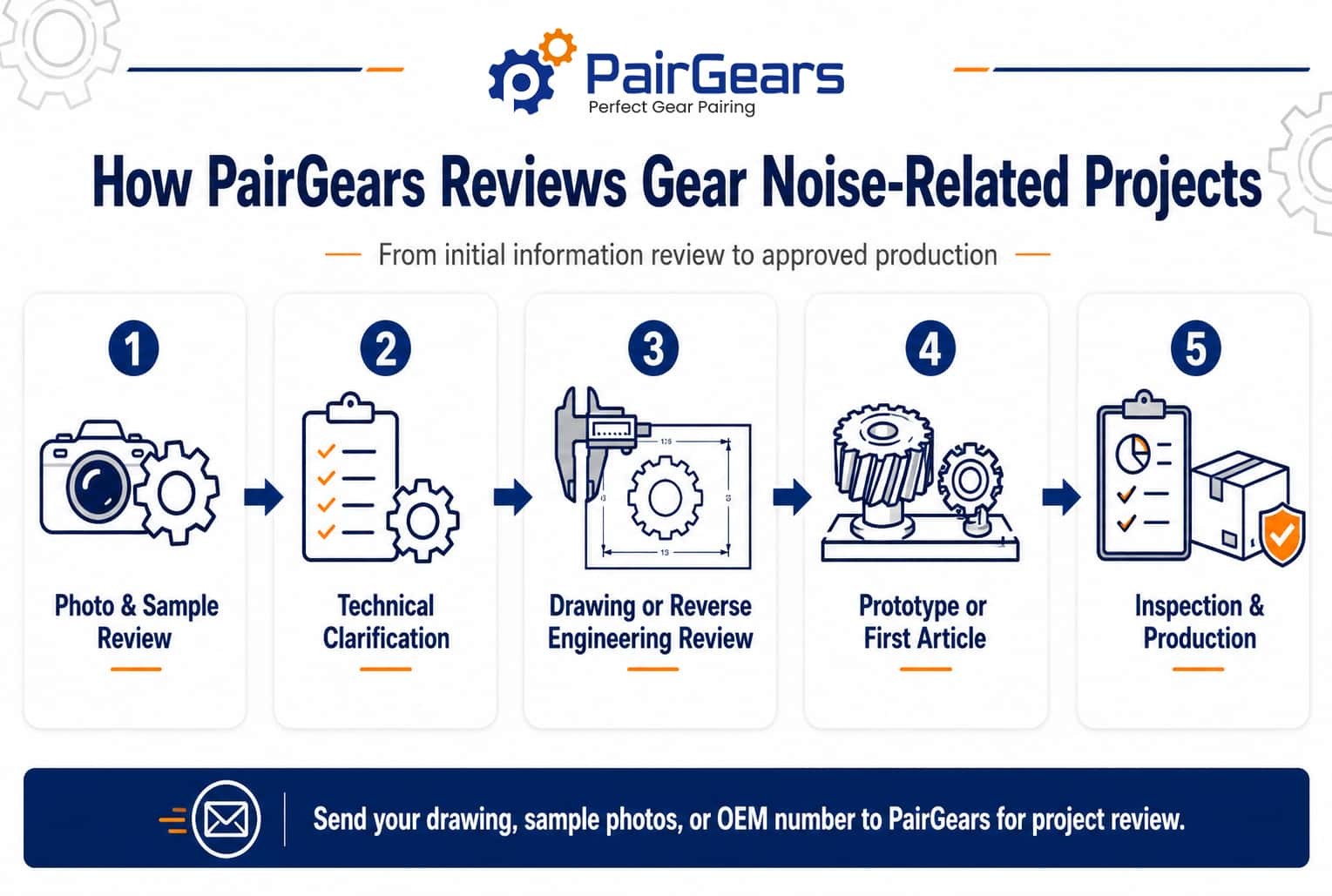
How PairGears Reviews Gear Noise-Related Projects
PairGears does not make a direct conclusion only because “the gear has noise.” Noise-related projects usually need a review of the old part, mating part, drawing, or sample information before deciding whether the project is suitable for quotation, measurement, prototyping, or further confirmation.
Photo and Sample Review
Check gear photos, old samples, OEM numbers, worn areas, bore or spline structure, and whether mating gear information is available.
Technical Clarification
Confirm gear type, material, heat treatment, accuracy, quantity, installation position, mating relationship, noise condition, and inspection requirements.
Drawing or Reverse Engineering Review
Use old sample measurement, reverse engineering, or mating-part confirmation when no complete drawing is available.
Prototype or First Article
Check dimensions, assembly, meshing, and inspection results before batch production.
Inspection and Production
Depending on the project requirements, inspection may include dimensions, runout, tooth profile, lead, hardness, visual condition, or mating checks.
Why Choose PairGears for Gear Noise-Related Projects
Gear noise is not always caused by the gear alone. It may also come from the mating part, assembly condition, lubrication, bearing support, or an incorrect replacement specification.
PairGears reviews gear noise-related projects by checking drawings, old samples, gear photos, OEM numbers, mating gear information, and visible wear conditions. If the original drawing is missing or the sample is heavily worn, sample measurement, reverse engineering, or prototype confirmation may be needed before production.
Depending on the project, inspection may include key dimensions, runout, tooth profile, lead, hardness, visual condition, or mating checks. For noise-sensitive projects, buyers may also review how gear accuracy grades affect cost, noise, and service life. This helps buyers decide whether the project is ready for quotation, needs more technical information, or should start with a first article before batch production.
- Drawing and sample review
- OEM number and photo review
- Mating gear information review
- Reverse engineering when required
- Prototype or first article support
- Inspection based on agreed scope
FAQ About Gear Noise
What is the most common cause of gear noise?
Common causes include tooth surface wear, pitting, incorrect backlash, poor contact pattern, assembly deviation, lubrication problems, and worn mating parts. The actual cause needs to be judged together with photos, samples, operating conditions, and inspection results.
Can a new replacement gear still make noise?
Yes. The new gear itself may not have an obvious problem, but if the mating gear is already worn, the installation position is incorrect, backlash has not been confirmed, or the bearing and shaft have runout, the new gear may still make noise after installation.
Is gear noise always caused by poor gear quality?
No. Gear manufacturing quality is only one possible factor. Noise may also come from assembly, mating parts, lubrication, bearings, working load, or incorrect replacement specifications.
What should buyers send when asking about gear noise?
Buyers should provide gear photos, mating gear photos, old samples or drawings, OEM numbers, equipment model, noise condition, lubrication condition, quantity, and inspection requirements.
Can PairGears quote a replacement gear if noise is the main problem?
PairGears can first review the project. Based on photos, drawings, old samples, OEM numbers, and mating-part information, PairGears can judge whether the project is suitable for quotation, sample measurement, reverse engineering, or first-article confirmation.
Conclusion
Gear noise does not always mean the gear itself is faulty. Wear, incorrect backlash, poor tooth contact, misalignment, bearing problems, lubrication, or mismatched replacement specifications can all contribute to the noise. That is why the gear and the surrounding assembly should be checked together before a replacement is ordered.
For a more accurate review, send us the available drawings, photos, old samples, OEM numbers, mating gear details, operating conditions, and inspection requirements.
Send Your Gear Noise Information for Review
If you are dealing with gear noise, wear, or an uncertain replacement, contact PairGears for a technical review and quotation.