Spur Gear Design Parameters Calculations and Materials
- Share
- publisher
- Jessica
- Issue Time
- Apr 14,2026
Summary
Spur gear design depends on geometry, strength, accuracy, and material choice. This guide explains key parameters, calculations, and material selection.

Introduction
In spur gear projects, many failures do not begin in service. They begin much earlier, when the wrong module is selected, the center distance is misjudged, or the material is chosen only by habit. A gear can look correct on paper and still end up too weak, too noisy, too large for the housing, or too expensive for the application.
At PairGears, we manufacture custom precision gears and gear sets for Agricultural Machinery, Heavy-Duty Trucks, Construction Equipment, and EV drivetrains. From a practical engineering point of view, spur gear design is not just about drawing teeth. It is about matching geometry, strength, speed, accuracy, material, and manufacturability so the gear pair can run safely, efficiently, and consistently in the real system.
What Spur Gear Design Really Means
Spur gear design is the process of defining the geometry, strength, ratio, material, and accuracy of a straight-tooth gear pair so it can transmit motion and torque reliably.
A spur gear may look simple, but good design is never only about one number. Tooth count affects ratio. Module affects tooth size and strength. Pressure angle changes tooth geometry and load direction. Center distance controls whether the pair will mesh correctly in the actual assembly. If one parameter is chosen without checking the others, the design may still fail even if each formula is technically correct.
In real production, design choices also affect manufacturability and cost. A larger module can improve root strength, but it also increases size and weight. A tighter accuracy grade can improve smoothness, but it raises manufacturing and inspection cost. A harder material can improve wear resistance, but without enough core toughness, it may chip under shock load. The best design is the one that fits the duty cycle, available space, and production route.
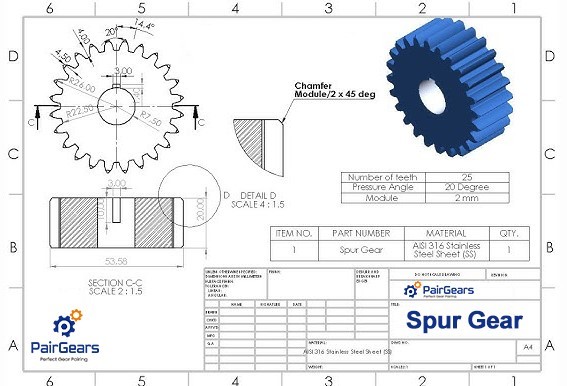
The Main Parameters That Shape a Spur Gear
Parameter | What it defines | Why it matters | Practical note |
Module (m) | Basic tooth size | Controls size, root thickness, and load capacity | Only matching modules can mesh correctly |
Tooth count (z) | Number of teeth | Determines ratio, pitch diameter, and undercut risk | Too few teeth can create undercut in standard designs |
Pressure angle (α) | Tooth load direction angle | Affects strength, meshing, and radial load | 20° is the common standard |
Pitch diameter (d) | Core reference diameter | Used in most geometry calculations | d = m × z |
| Center distance (a) | Distance between two gear axes | Affects assembly and meshing stability | Must match the design condition |
Addendum / dedendum | Tooth height above and below pitch circle | Influences full tooth height and clearance | Standard values are common but not universal |
| Face width (b) | Tooth width along the axis | Affects contact load and strength | Often selected as a range relative to module |
| Profile shift (x) | Cutter displacement factor | Prevents undercut, adjusts center distance, improves strength | Useful in optimization, not only correction |
| Accuracy grade | Manufacturing precision level | Affects noise, vibration, and consistency | Must match application need |
Surface roughness | Micro-finish of tooth surface | Influences lubrication, wear, and fatigue | Tied to both process route and grade target |
These parameters do not work independently. In practical design work, changing one usually changes the meaning of the others. That is why spur gear design is always a balance, not a checklist.
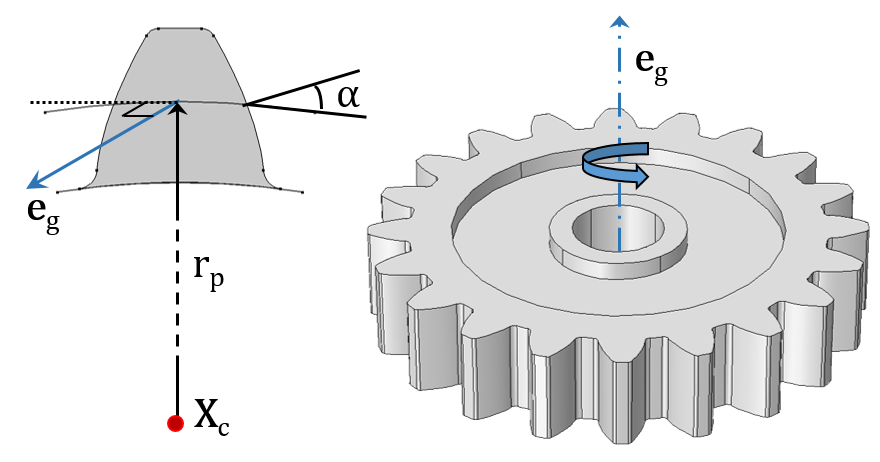
Where Spur Gear Design Choices Matter Most
● Agricultural Machinery
Mixed loads, dirt, long duty cycles, and practical maintenance needs make strength, manufacturability, and replacement logic especially important.
● Heavy-Duty Trucks
High torque density and long-life targets require stable tooth geometry, strong root design, and materials that balance hard surfaces with tough cores.
● Construction Equipment
Shock load and start-stop operation make bending strength, contact durability, and material toughness more critical than theoretical compactness alone.
● EV Drivetrains
Higher speed and tighter NVH expectations make smooth running, accuracy grade, and surface finish more important in the final design balance.
What Engineers Usually Calculate and Check
| Item | Basic relationship or focus | Why it matters |
| Transmission ratio | i = z₂ / z₁ = n₁ / n₂ | Defines speed relationship between shafts |
| Pitch diameter | d = m × z | Core dimension for size and meshing geometry |
| Center distance | a = m(z₁ + z₂) / 2 for standard zero-shift gears | Determines installation geometry |
Addendum circle diameter | da = m(z + 2) | Helps define outer size and tooth tip diameter |
Root circle diameter | df = m(z − 2.5) for standard non-shift gears | Important for root region and strength review |
Pitch line velocity | Based on rotational speed and pitch diameter | Helps classify speed level and lubrication need |
Bending strength | Root stress must stay below allowable bending stress | Prevents tooth root fatigue or shock breakage |
Contact strength | Contact stress must stay below allowable contact stress | Prevents pitting, wear, and scuffing |
The formulas are only the starting point. A design becomes practical only when these numbers are matched to the real load case, space limit, process route, and material choice.
A common RFQ problem is to specify module and tooth count, but leave load, speed, or accuracy undefined. That may be enough to quote a part, but it is not enough to judge whether the design margin is truly suitable.
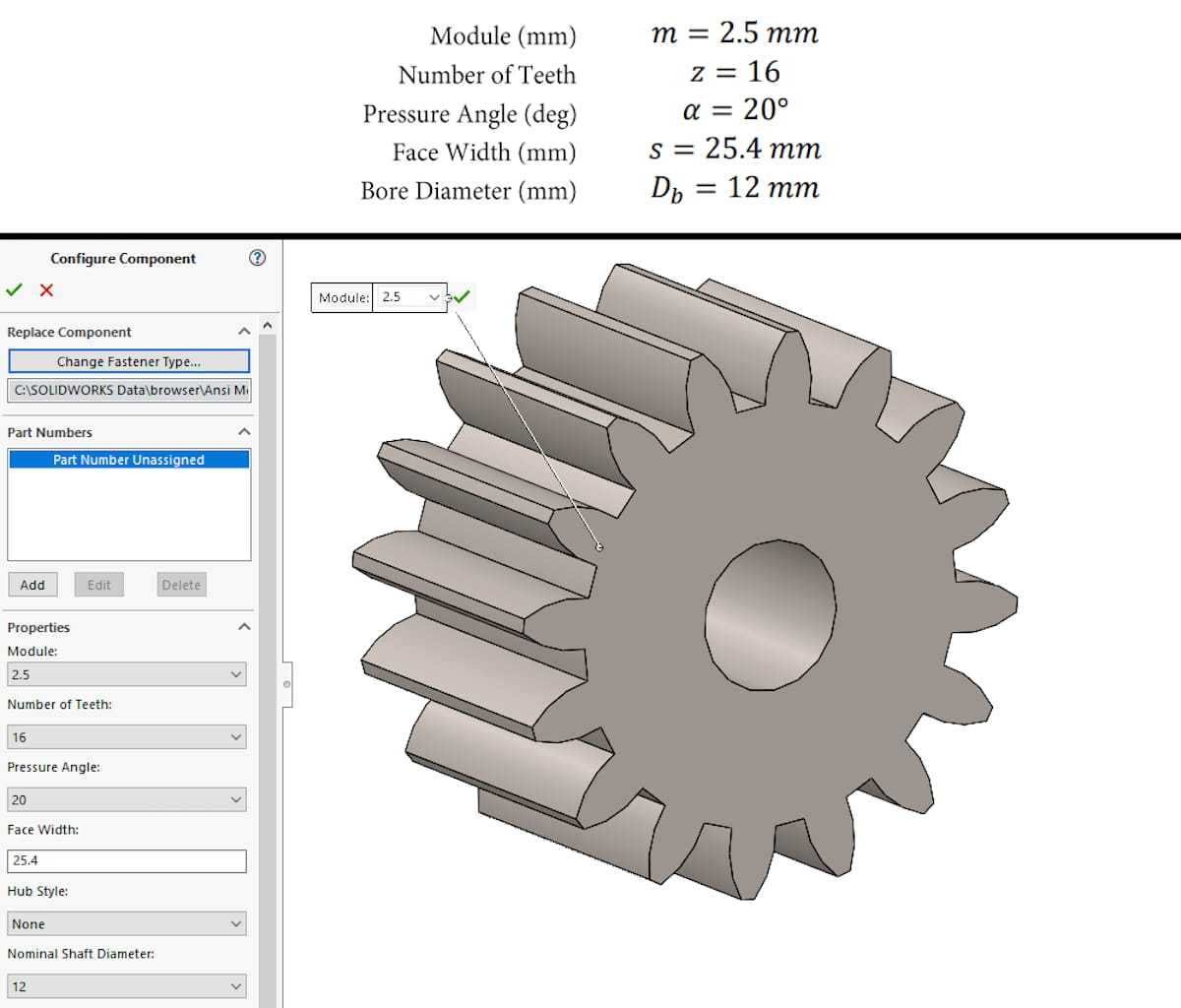
How Material Choice Changes the Result
Gear material selection should follow the real design conditions, not just the drawing size. Torque level, pitch line velocity, shock load, lubrication condition, and target life all influence which material and heat treatment make sense.
A practical route often looks like this:
●Lower torque, cost-sensitive projects may allow simpler steels or even cast iron or engineering plastics in light-duty applications.
●Medium-load industrial gears often use carbon steel such as 45 steel or alloy steels like 40Cr after normalizing or quench-and-temper treatment.
●Higher-load and wear-critical gears often move to carburized steels such as 20CrMnTi to combine a hard tooth surface with a tougher core.
●Quiet, light-load, compact products may use materials such as POM, PA66, or PEEK where weight, corrosion resistance, and low noise are more important than heavy torque.
The key point is simple: material cannot fix a weak geometry by itself. A stronger steel helps, but if the module is too small or the tooth count creates undercut, the base design risk remains.
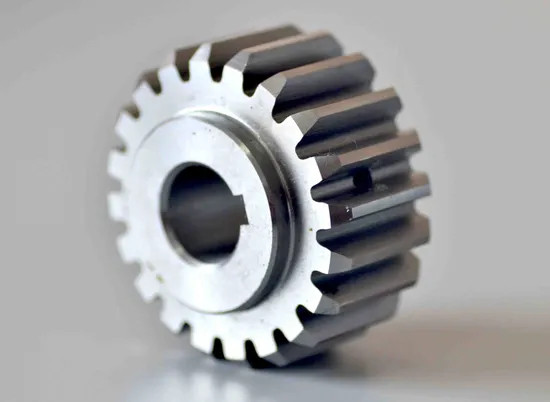
What Good Spur Gear Design Improves
| Benefit | What improves | Practical result |
| Better load capacity | Root thickness and contact area match the duty | Lower breakage and wear risk |
| Better meshing stability | Geometry and center distance are matched correctly | Lower noise and smoother running |
| Better manufacturability | Design fits standard tools and practical routes | Lower production risk and cost |
Better material efficiency | Material is chosen to match actual duty | Better cost-performance balance |
Better repeatability | Accuracy and inspection targets match the application | More stable batch-to-batch performance |
From a sourcing point of view, good spur gear design reduces more than field failures. It also reduces clarification loops, sample rework, and the common problem of "the gear fits dimensionally, but not functionally."
How to Review a Spur Gear Design with a Supplier
●Start with load, speed, and ratio together.
Module and tooth count cannot be judged properly unless torque, speed, and ratio are reviewed as one system.
●Ask how strength and geometry are balanced.
A supplier should be able to explain whether the design is driven more by bending strength, contact stress, space limit, or smoothness target.
●Confirm the material and heat-treatment logic.
Material should not be chosen only by habit. It should match the actual load, shock, wear, and cost target.
●Check whether the design fits the manufacturing route.
Some theoretical parameter combinations are possible on paper, but difficult to hold consistently in repeat production.
●Review inspection expectations early.
Accuracy grade, runout, profile, lead, and roughness should be discussed before the design is locked if they matter to the application.
This part is especially important for custom gears. A standard-looking spur gear can still be highly application-specific once load spectrum, noise target, and material route are considered.
Why Choose PairGears
At PairGears, we do not treat spur gear design as only a geometry exercise. We connect gear parameters, strength review, material route, and manufacturing practicality into one decision process.
We focus on:
●application-fit review for Agricultural Machinery, Heavy-Duty Trucks, Construction Equipment, and EV drivetrains
●practical balance between module, tooth count, strength, size, and cost
●material and heat-treatment selection that matches real duty rather than general assumptions
●geometry review that considers both calculation and production repeatability
●support from drawing clarification through repeat batch manufacturing
For many customers, the value is not only in receiving a finished spur gear. It is in reducing the design mistakes that become expensive later.
FAQ
Q1: How Do I Choose The Module Of A Spur Gear?
The module should be selected by balancing torque, strength, and available space. If bending or contact strength is not enough, the module often needs to increase.
Q2: Why Does Pressure Angle Matter In Spur Gear Design?
Because it affects tooth shape, bending strength, radial load, and meshing behavior. A larger angle can improve strength, but it also increases bearing-related load effects.
Q3: Can I Choose Material Only By Load Level?
No. Material choice should also consider speed, wear, shock, lubrication, heat-treatment route, and cost target.
Q4: Why Do Two Gears With The Correct Ratio Still Perform Poorly?
Because ratio alone is not enough. Module, pressure angle, center distance, accuracy, material, and assembly conditions all affect the final result.
Q5: How Do I Choose Between ISO And AGMA Accuracy Systems?
That usually depends on market and project standard logic. European and general machinery projects often follow ISO, while North American and some automotive or heavy-industry projects often reference AGMA. One project should stay consistent within one system.
Conclusion
Spur gear design is not just about drawing a gear with the correct ratio. It is a practical engineering process that connects parameters, strength, accuracy, material, and manufacturability into one workable solution. A good design should not only calculate correctly, but also fit the real duty cycle, assembly condition, and production route.
If you are preparing an RFQ, reviewing a spur gear drawing, or comparing material and parameter options, you are welcome to Contact Us with your drawing, load data, speed, ratio target, and material preferences so we can help align the design with a practical manufacturing and inspection plan.