Planetary Transmission Gear: What Buyers Should Check
- Share
- publisher
- Jessica
- Issue Time
- Jun 29,2026
Summary
Learn what buyers should check before ordering a planetary transmission gear, including fit, tooth data, material, heat treatment and inspection.

Introduction
In agricultural machinery, construction equipment, heavy-duty transmission and EV reduction systems, a planetary transmission gear rarely works alone. It usually works with the sun gear, planet gears, ring gear, carrier, bearings and housing.
That is why buyers should not judge this type of gear only by outside diameter, tooth count, or whether an old part looks similar. If tooth data, bore fit, material or heat treatment is different, the new gear may not mesh smoothly after assembly.
For PairGears, a planetary transmission gear project is usually reviewed together with the drawing, sample, OEM number, application position and inspection requirements. Clear RFQ information helps the supplier judge feasibility, process route, quotation and lead time more accurately.
Quick Answer: What Is a Planetary Transmission Gear?
A planetary transmission gear is a gear part or gear combination used in a planetary transmission system. It usually works with the sun gear, planet gears and ring gear to transmit torque, reduce speed and distribute load in a compact structure.
For buyers, the key question is not only what it is, but whether it can match the original transmission system. Before ordering, buyers should confirm tooth count, module or DP, pressure angle, face width, bore, spline, material, heat treatment and inspection requirements.
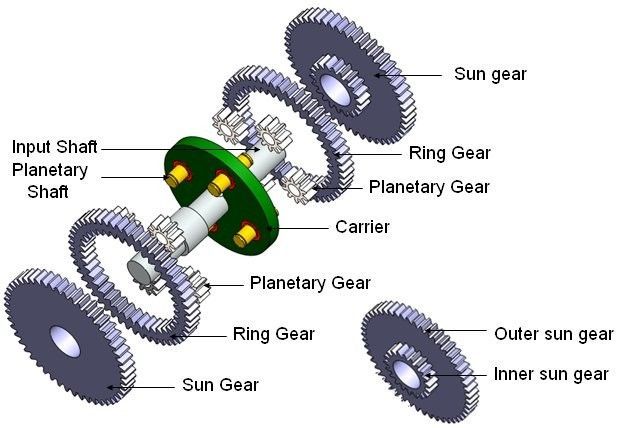
Where Are Planetary Transmission Gears Used?
Planetary transmission gears are used where compact structure, high torque and stable transmission are required. Different applications bring different sourcing priorities.
| Application Field | Common Use | What Buyers Should Focus On |
| Agricultural machinery | Tractors, harvesters, agricultural transmission systems | Wear resistance, replacement matching, long-term supply |
| Construction equipment | Travel drives, slewing mechanisms, construction vehicles | Impact load, tooth strength, heat treatment |
| Heavy-duty transmission | Heavy-duty vehicles, commercial transmission components | Spline fit, load capacity, batch stability |
EV reduction system | EV reduction systems, electric equipment transmission | Tooth accuracy, assembly consistency |
Even if two parts are both called planetary gears, their load condition and failure cause may be different. A part name alone is usually not enough for an accurate quotation.
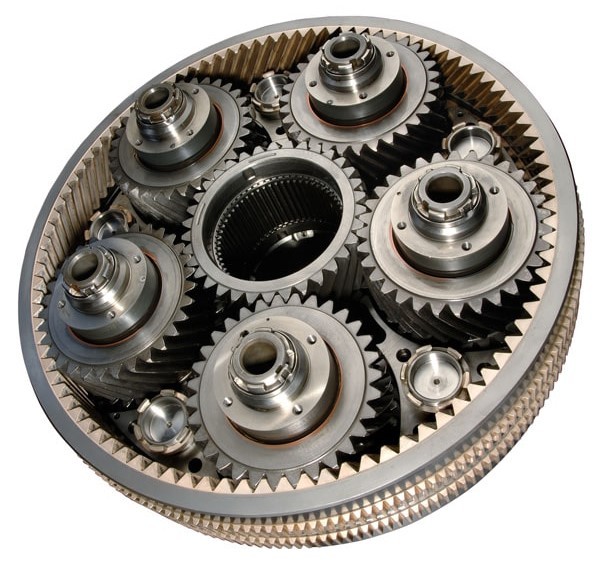
Why Planetary Transmission Gear Matching Matters
Gears in a planetary transmission structure work as a set. A small parameter difference in one planetary transmission gear may affect the meshing condition of the whole gear set.
Basic Dimensions Are Not Enough
Some replacement projects start by measuring outside diameter, bore and tooth count. These are useful, but they are not enough.
The following details also need confirmation:
◇module or DP
◇pressure angle
◇face width
◇tooth profile or modification requirements
◇spline, keyway or bore fit
◇meshing relationship with matching gears
A sample that looks similar does not always mean the new gear will run stably after assembly.
Worn Parts Can Affect Measurement
Many replacement planetary gear projects start from an old part. The old part may already have wear, pitting, broken teeth or deformation.
If the new gear is copied only from worn dimensions, the error may continue into the new part. In this case, the supplier should review the sample condition, matching parts, OEM number and application position together.
What Buyers Should Check Before Ordering
Before ordering a planetary transmission gear, buyers can prepare the following information to reduce quotation errors and repeated confirmation.
| Check Point | What Buyers Should Provide | Why It Matters |
| Drawing or sample | 2D/3D drawing, physical sample, sample photos | Confirms the production basis |
Tooth data | Tooth count, module/DP, pressure angle, face width | Affects meshing |
Fit dimensions | Bore, outside diameter, end face, spline, keyway | Affects assembly |
| Material | Material grade or performance requirement | Affects strength and wear resistance |
| Heat treatment | Carburizing, quenching, hardness, case depth | Affects tooth surface life |
Accuracy requirement | ISO/AGMA grade or inspection requirement | Affects batch stability |
Matching parts | Sun gear, ring gear or planet gear information | Avoids mismatch |
Quantity | Sample quantity, batch quantity, annual demand | Affects quotation and lead time |
Application | Equipment type, working position, load condition | Helps judge the process route |
If there is no complete drawing, buyers can first provide sample photos, key dimensions, OEM number and application information. For replacement projects, these details are often more useful than a part name alone.
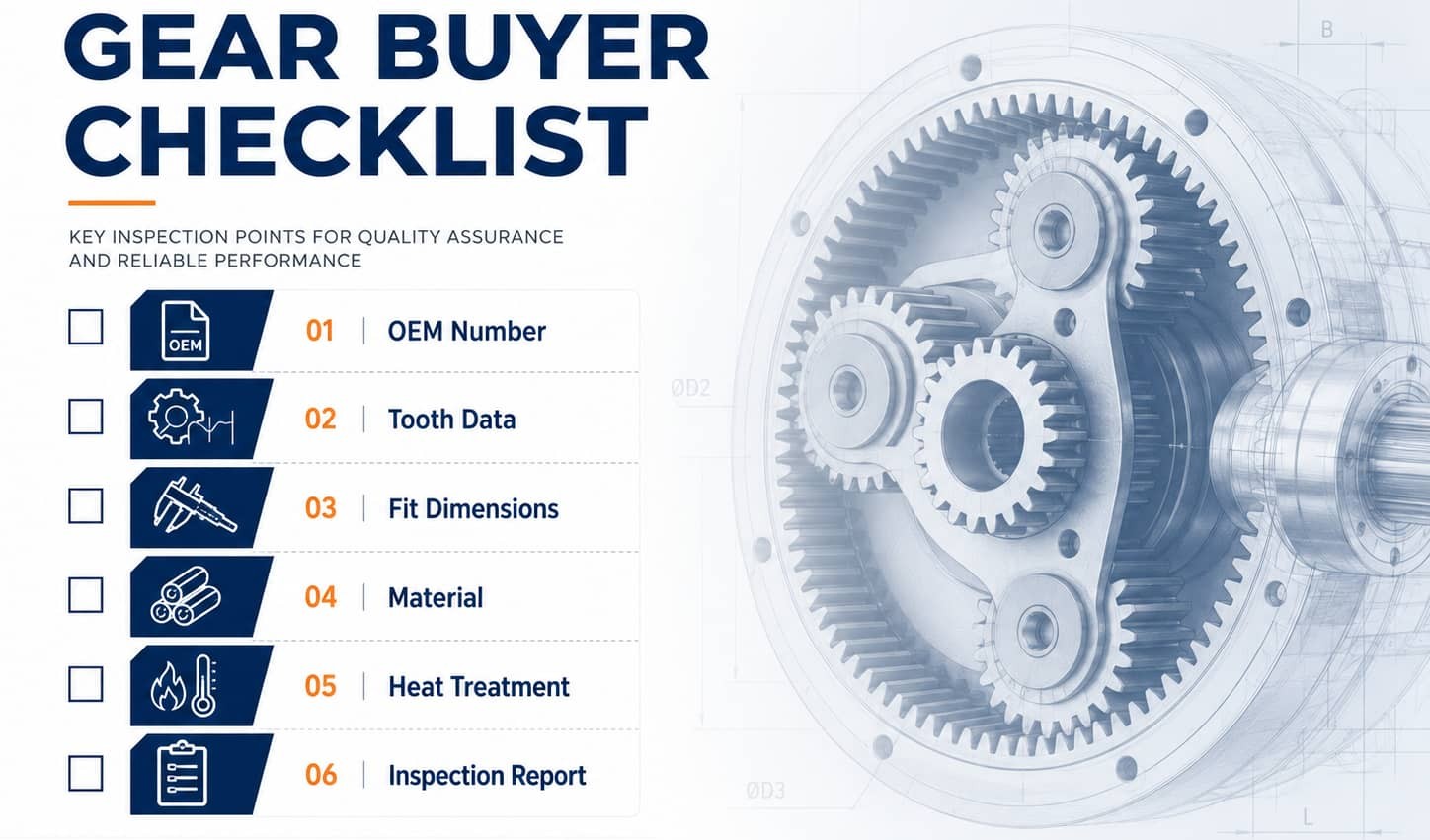
Key Data Needed for a Planetary Gear RFQ
A clear RFQ helps the supplier judge project feasibility faster.
Basic Information
▷2D drawing or 3D model
▷physical sample or photos from different angles
▷OEM number or original part number
▷tooth count, outside diameter, bore and face width
▷spline, keyway, step or end-face structure
▷order quantity and target lead time
Technical Requirements
▷material grade
▷heat treatment method
▷surface hardness and core hardness
▷case depth or hardened layer requirement
▷accuracy grade
▷inspection report requirements
▷packaging and rust prevention requirements
Application Information
Application information helps the supplier judge the right process focus.
For example, agricultural machinery projects often focus on wear resistance and long-term supply. Construction equipment projects care more about impact load. EV reduction systems usually require better tooth accuracy and assembly consistency.
Common Mistakes When Replacing Planetary Transmission Gears
Copying the old part too directly
Old gears may already have worn tooth surfaces, enlarged bores, or damaged end faces. If these dimensions are copied without review, the new part may carry the same errors into production.
The safer approach is to use the old gear as a reference, then verify it with matching parts, drawings, or original parameters when possible.
Ignoring the gear set relationship
A planetary transmission gear usually works with the sun gear, ring gear, or other planet gears. Checking only one gear may not be enough.
Even if the single part looks correct, poor set matching can still cause unstable meshing, noise, or early wear.
Missing heat treatment and inspection details
Material grade alone is not enough for a reliable RFQ. Buyers should also confirm hardness, case depth, heat treatment method, and inspection requirements.
Clear data helps suppliers avoid guesswork and makes the quotation more realistic.
Comparing only unit price
A low unit price may become expensive if it leads to rework, assembly issues, or unstable repeat batches.
For replacement and long-term supply projects, process control and batch consistency are often more important than the first quotation.
How PairGears Reviews Planetary Transmission Gear Projects
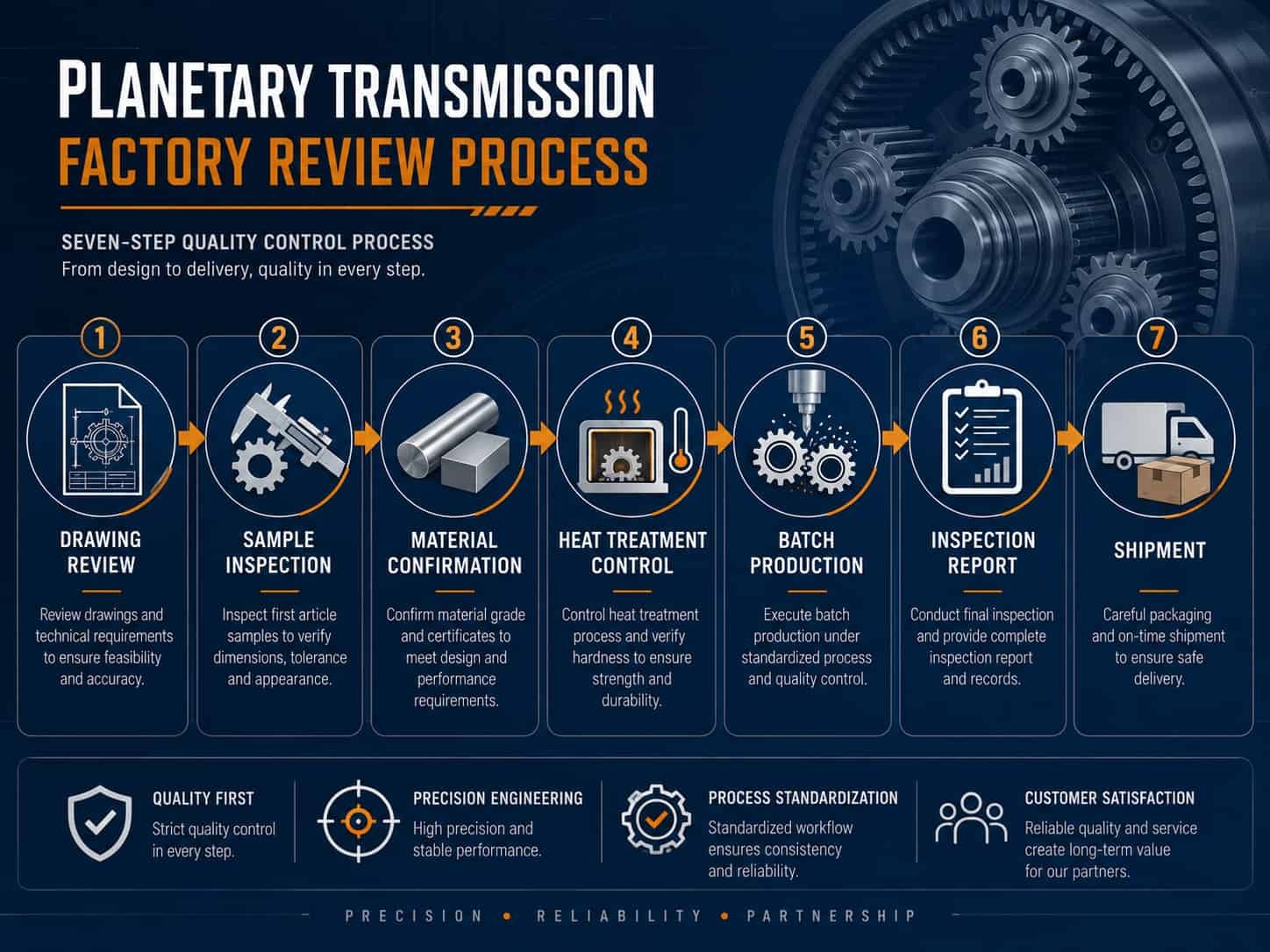
When reviewing a planetary transmission gear project, PairGears first looks at how the gear works inside the transmission system, not only at the part name or basic dimensions.
Drawing and sample review
PairGears checks drawings, samples, OEM numbers, tooth data, key dimensions, material, heat treatment, and inspection requirements. If only an old sample is available, wear and deformation are reviewed before dimensions are used for production.
Matching and process check
For planetary gear set projects, PairGears reviews how the part matches with the sun gear, ring gear, or other planet gears. Based on the application, load condition, and working environment, the suitable machining and heat treatment route can then be evaluated.
Inspection and repeat-order support
For repeat orders or long-term supply, inspection records help track batch consistency. Key dimensions, hardness, tooth profile, lead inspection, and appearance checks can support future comparison and stable supply.
Buyers can send drawings, sample photos, OEM numbers, quantity, and application details to PairGears for an initial project review.
FAQ
Q1: What is a planetary transmission gear?
A planetary transmission gear is part of a planetary drive system. It normally works with the sun gear, planet gears and ring gear to transmit torque, reduce speed and share load in a compact structure.
Q2: Can I order a planetary gear without a full drawing?
In some cases, yes. A sample, clear photos, OEM number, key dimensions and application details can help start the review. A complete drawing or sample measurement will make the quotation more reliable.
Q3: What should I check before replacing a planetary transmission gear?
Do not check only the outside diameter and tooth count. Buyers should also confirm tooth data, bore or spline fit, material, heat treatment, matching gears, inspection needs and whether the old sample is already worn.
Q4: Why does heat treatment matter for planetary gears?
Heat treatment has a direct effect on surface hardness, wear resistance and fatigue strength. For heavy-duty applications, an unsuitable or unstable heat treatment process can shorten the gear’s service life.
Q5: What information helps PairGears quote faster?
Drawings, samples, OEM number, quantity, material, heat treatment, application, target lead time and inspection requirements all help PairGears review the project faster and give a more practical quotation.
Conclusion
A planetary transmission gear may look like one gear part, but it usually works inside a complete transmission system. Buyers should not evaluate it only by size, tooth count or price.
Before ordering or replacing one, confirm the drawing, sample condition, tooth data, material, heat treatment, matching parts and inspection requirements. These details help reduce wrong-part risk before production starts.
If you are sourcing planetary transmission gears for agricultural machinery, heavy-duty transmission, construction equipment or EV reduction systems, contact PairGears and share your drawing, sample photos, OEM number or application details. The team can help review what information is still needed before quotation.