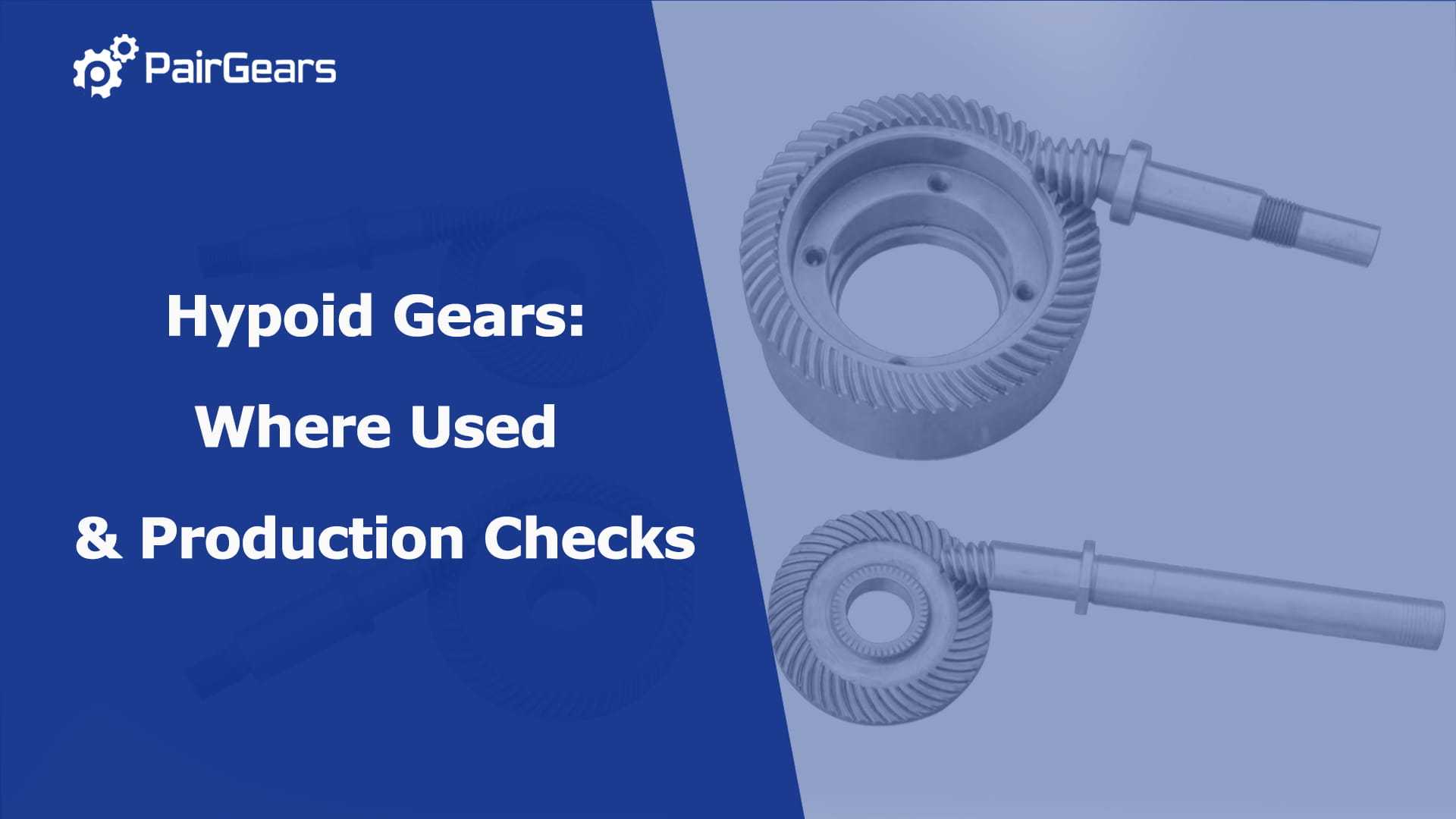
Hypoid Gears: Where Used & Production Checks
- Share
- publisher
- Jessica
- Issue Time
- Jan 14,2026
Summary
Where hypoid gears are used in agriculture, truck, construction & EV—and what matters in production: mounting distance, backlash and contact pattern checks.
1. Introduction
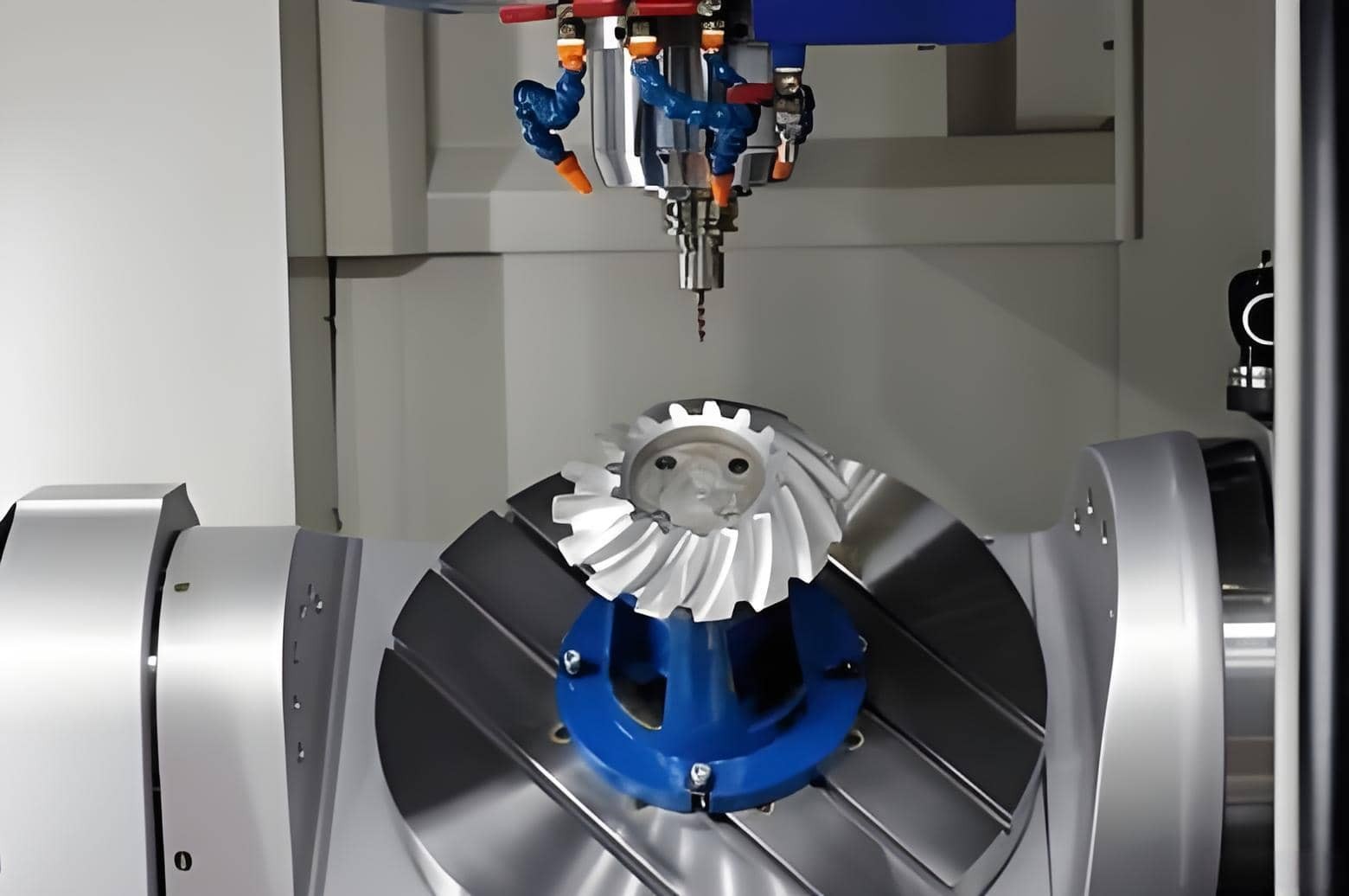
Hypoid gears are often discussed like a "gear type" but on the factory floor they behave like a system. Buyers usually come to us with practical constraints: tight packaging, high torque, long duty cycles, and consistent acceptance in assembly.From our manufacturing perspective, hypoid projects run smoothly only when the customer and supplier align early on four items: mounting references, backlash target, contact pattern target, and a production route that keeps those targets stable after heat treatment.
PairGears supplies precision gears and shafts for agricultural machinery, heavy-duty truck, construction equipment, and electric vehicle system, and we build hypoid solutions when your layout requires an offset angle-drive stage.
2. A one-line definition
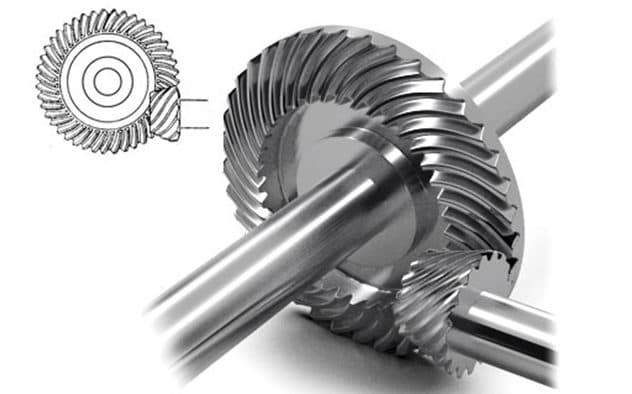
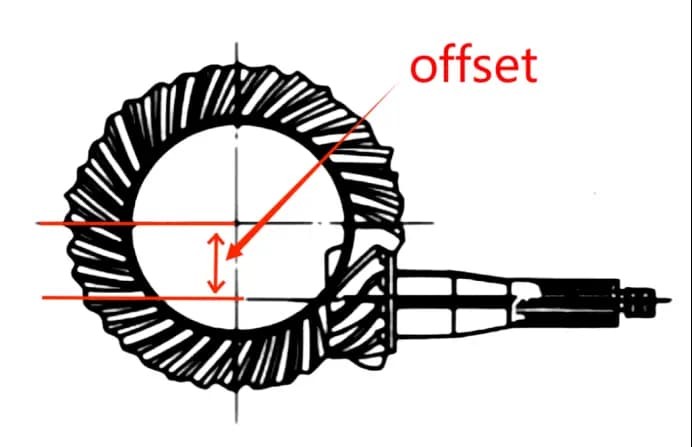
A hypoid gear is an offset angle-drive gearset (similar to spiral bevel) where the pinion and gear axes do not intersect, enabling compact layouts while transmitting torque.
3. Why hypoid gears matter
Packaging is the first reason.
The axis offset lets designers place shafts where the housing, bearings, and surrounding components can actually fit—often the difference between a workable drivetrain layout and a redesign.
Load capacity depends on stable contact, not just geometry.
Hypoid gears can carry heavy torque, but only if the project defines a repeatable assembly window: mounting distance + backlash + contact pattern acceptance. Without these, "dimensionally OK" parts can still perform inconsistently in the real axle housing or angle-drive unit.
Sliding is the trade-off you must engineer around.
Hypoid gears have higher sliding on the tooth flank than intersecting-axis bevel gears, so surface condition, heat-treatment consistency, and lubrication expectations become more critical in heavy-duty duty cycles.
Lubricant performance reference (automotive hypoid gear units): SAE J2360.
4. Common hypoid "types" buyers source
| Type (practical sourcing view) | What's different | Typical application | What must be defined before cutting |
| Hypoid ring and pinion (matched set) | Large ring gear + offset pinion | Axles, main reduction stages | Ratio/tooth counts, offset, mounting distance, backlash, pattern target |
| Packaging-driven axle/final-drive layouts with tight envelope | Larger offset for compact packaging | Tight housings, short drivetrain envelopes | Mounting references + pattern acceptance method |
| General heavy-duty angle drives with moderate packaging limits | Smaller offset (closer to spiral bevel) | Moderate packaging constraints | Backlash window + inspection method |
Above-center / below-center pinion layout | Pinion position relative to ring centerline | Layout-driven (driveline height, housing) | Assembly datums, shim strategy, acceptance criteria |
Service/aftermarket replacement sets | Interchange + receiving clarity | Repair channels, rebuilders | Clear marking, pairing, and traceability rules |
5. Who uses hypoid gears in various fields
5.1 Agricultural machinery
axle/final-drive angle stages and heavy reduction modules where compact packaging and high torque are required.
What we see most: long duty hours, dust/water exposure, low-speed high-torque work
What must be clear: mounting distance reference + backlash target + pattern acceptance in the real housing
5.2 Heavy-duty truck
rear-axle main reduction (ring & pinion) and drivetrain angle-drive stages with long-life targets.
What we see most: batch-to-batch consistency and service replacement expectations
What must be controlled: matched-set handling (pairing/marking/packing) + repeatable contact checks
5.3 Construction equipment
high-load angle drives in off-road axles and heavy-duty reduction stages with load changes and occasional shock loads.
What we see most: surface distress risk if lubrication/heat-treat stability drifts
What must be verified: contact stability after heat treat + defined acceptance records
5.4 Electric vehicle (EV)
Used in some axle-style or packaging-driven layouts; if your design uses an offset angle-drive stage, we manufacture to drawing and agreed acceptance criteria.
6. Key features that decide whether a hypoid set “runs right”
| Feature | What it means in real builds | Factory controls / checks |
Axis offset geometry | Enables compact layout and shaft placement | Confirm offset and assembly datums early |
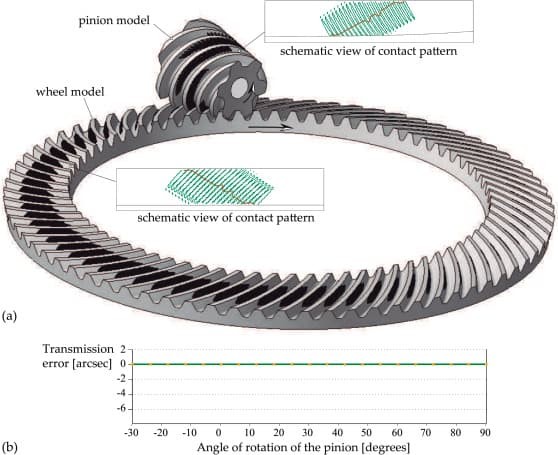
Contact pattern sensitivity | Dimensional pass ≠ functional pass | Pattern target + pattern record as a gate |
Mounting distance dependence | Small shifts move the contact | Agreed mounting distance & measurement reference |
| Backlash window | Too tight/loose changes performance and heat | Backlash target + method (how/where measured) |
| Sliding + rolling motion | Surface & lubrication become critical | Surface condition, heat treat stability, oil assumptions |
| Matched-set behavior | Gear and pinion behave as one system | Pairing, marking, packing segregation |
Heat-treatment distortion risk | Distortion moves contact and backlash | Route planning + post-HT recovery plan |
Traceability for repeat orders | Repeatability across batches | Lot control, inspection record consistency |
Practical note: for hypoid, we treat contact pattern verification as functional acceptance, not a "nice-to-have"
Background on tooth contact analysis (TCA): NASA technical report (spiral bevel and hypoid gears)
7. Practical benefits buyers care about
| Benefit | Where it helps most | What buyer problem it solves |
More flexible packaging | Axles, compact housings | “We need it to fit without redesign.” |
High torque capability (when set correctly) | Truck, Construction, Agricultural | “Will it survive real loads?” |
| Stable torque transfer | Heavy-duty drivelines | “Will contact stay stable after assembly?” |
| Clear functional acceptance | OEM + rebuild channels | “Can we inspect and approve consistently?” |
Better system integration | Housing + bearing layouts | “Can we meet bearing span / housing constraints?” |
Repeatable supply when data is locked | Batch production | “Can we reorder with confidence?” |
8. Supplier selection tips
① Ask how they confirm mounting distance, not only tooth counts. A hypoid quote without mounting references often turns into rework later.
② Require a defined contact pattern acceptance method. You want an agreed target and a repeatable check method—especially for axles and matched sets.
③ Check their plan for heat-treatment distortion control. Hypoid is sensitive to post-HT movement; the supplier should explain how they keep the functional window stable.
④ Verify matched-set handling (pairing + marking + packing). Many costly issues happen after shipping due to mix-ups, not machining.
⑤ Make sure their inspection records match your approval process. Runout on agreed datums, hardness/case depth (if required), and pattern records should be deliverable in your format.
9. Why choose pairgears
●Built for real drivetrain sectors
We supply gears and shafts for agriculture, trucks, construction, and EV systems, with manufacturing decisions driven by duty cycle and assembly reality.
●Capability coverage for end-to-end control
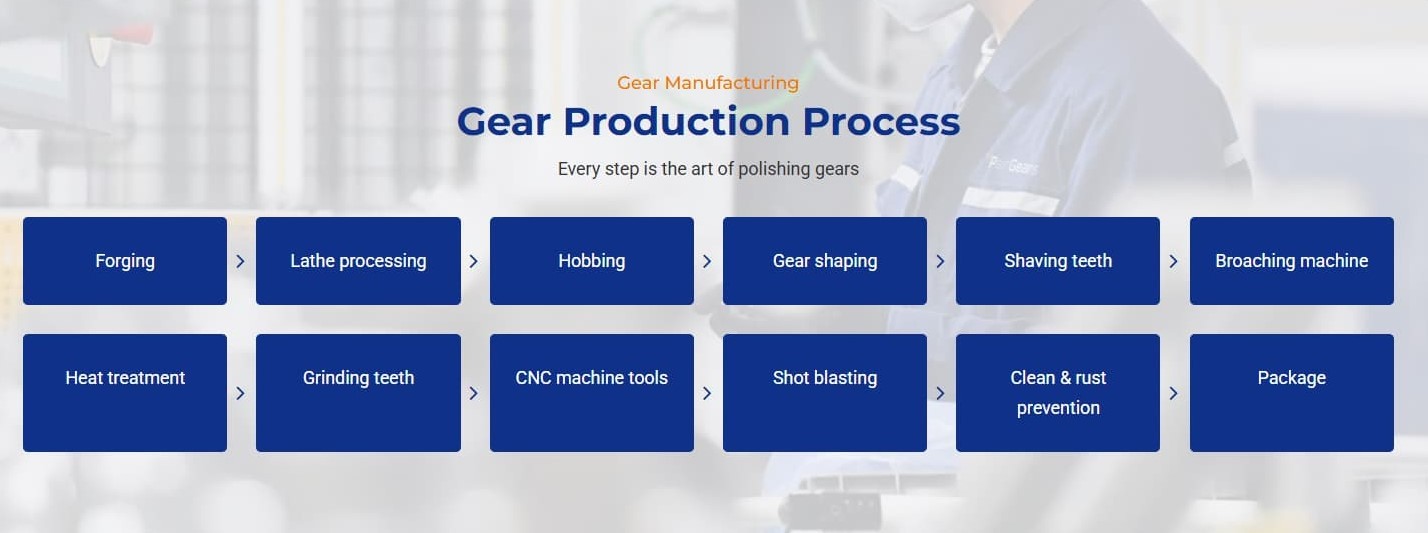
Our equipment base supports core machining and finishing steps, and we align the manufacturing route with your functional targets and inspection plan.
●Functional acceptance, not just dimensional sheets
For hypoid projects, we align pattern/backlash/mounting references early and treat pattern verification as a functional gate where required.
●Matched-set discipline for axles and reduction stages
Pairing, marking, and packing segregation are managed as “must-have” actions for matched ring & pinion style projects.
●Simple RFQ workflow that improves quote accuracy
Drawing/sample/OEM reference + duty cycle notes → manufacturability review → quote + inspection record alignment → pilot → repeat orders.
10. FAQ
Q1: What Do You Need To Quote A Hypoid Gearset Accurately?
At minimum: ratio/tooth counts, shaft angle, and offset. For a repeatable build, we also need mounting distance reference, backlash target, and your contact pattern acceptance method (or reference photos/spec). If you only have a sample/OEM reference, we can start there and confirm the critical datums.
Q2: Why Do Hypoid Projects Fail Even When Dimensions Look Correct?
Because hypoid performance depends heavily on functional alignment—mounting distance, backlash window, and the resulting contact pattern in the real housing. If these are not defined (or not repeatable), contact can drift after assembly or heat treatment.
Q3: How Is Contact Pattern Checked For Hypoid Gears?
The key is to agree on how the pattern is generated and judged: preload, shimming method, marking compound method, and what “acceptable” looks like. Once agreed, pattern checks become a repeatable functional gate rather than a subjective photo.
Q4: Can You Supply Hypoid Ring & Pinion As A Matched Set?
Yes. When a project requires matched sets, the gear and pinion are managed together through pairing, marking, traceability, and packing segregation to reduce receiving-side mix-ups.
Q5: Can Hypoid Gears Be Used In EV Drivetrains?
They can be used in certain layouts, especially where packaging or axle-style architecture benefits from an offset angle-drive stage. If your EV module needs gears/shafts, we also support drawing/OEM-based supply through our EV gears & shafts category.
11. Conclusion
Hypoid gears are chosen because the axis offset unlocks packaging options while supporting high torque transmission. But in real production, results depend less on the label "hypoid" and more on whether the project locks down the build window: mounting distance, backlash target, contact pattern acceptance, and a heat-treatment + inspection plan that keeps those targets stable.
Contact us and share a drawing, sample, or OEM reference with duty cycle notes. We'll start with a manufacturability review and align the inspection records you need for approval.