How to Compare Precision Gear Suppliers for Repeat Orders
- Share
- publisher
- Jessica
- Issue Time
- Jun 25,2026
Summary
Learn what to compare when choosing precision gear suppliers for repeat orders, including sample approval, inspection records, traceability, and lead time.
Getting the first sample right only means the project has started well. It does not mean every later batch will naturally stay stable. Once a project moves into the second or third order, the real question is no longer "Can this supplier make it?" but "Can this supplier keep making it to the same confirmed standard?"
For PairGears, which supports both custom and replacement gear projects, repeat orders are not just about making the same part again. They depend on whether approved samples, drawing versions, material routes, heat treatment requirements, and inspection standards can be carried forward in a stable way. For buyers, this usually matters more than saving a little money on the first order, because once batch variation begins, the impact is no longer only about price. It can affect assembly, service life, delivery, and customer trust.
Quick Answer
When comparing precision gear suppliers for repeat orders, the key point is not the first-order price alone. The real question is whether the supplier can carry the approved sample, drawing, process route, and inspection standard into later batches without unnecessary variation.
The most useful things to compare are usually sample approval control, material and heat treatment consistency, continuity of inspection records, batch traceability, lead time stability, and change management.
Why Precision Gear Suppliers Must Prove Stability in Repeat Orders
A first order usually has a strong development and confirmation stage. Both sides spend more time checking drawings, dimensions, materials, heat treatment, application conditions, and inspection methods. Problems are easier to see during sampling.
Repeat orders are different. They show whether the supplier can keep following the confirmed standard even when there is less back-and-forth communication. In simple terms, a first order mainly shows whether the supplier can make the part. Repeat orders show whether the supplier can keep making it in a stable way.
A first order shows whether the part can be made correctly
During the first sample stage, buyers usually focus on whether the part can be produced, assembled, and used as expected. At this stage, the main task is to get the direction right.
Repeat orders show whether the process can stay stable
Once the project moves into repeat supply, buyers usually care more about:
●whether later batches stay close to the approved sample
●whether material and heat treatment remain consistent
●whether inspection records can be matched to each batch
●whether lead time becomes less stable over time
●whether changes are clearly recorded and confirmed
What Buyers Should Compare in Precision Gear Suppliers
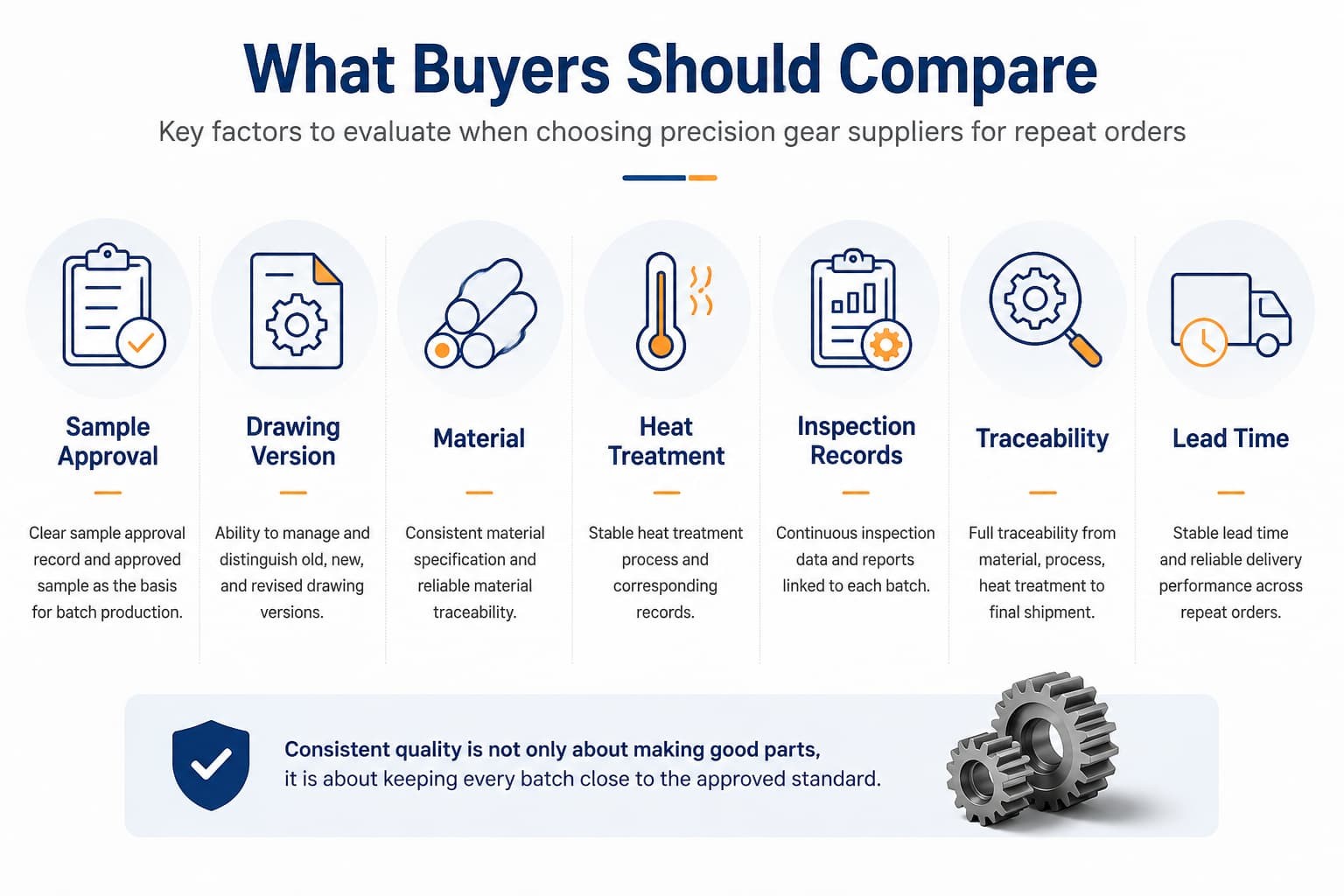
For repeat orders, the real value is not a simple statement like "our quality is stable." Buyers should compare whether the supplier has clear control methods and usable records.
| Comparison Point | What Buyers Should Check | Why It Matters |
| Sample approval logic | Whether there is a clear sample approval record, approved sample, and linked drawing version | Later batches should follow the approved standard |
| Drawing and version control | Whether old, new, and revised versions can be clearly separated | Helps prevent production to the wrong version |
| Material and heat treatment consistency | Whether material route, heat treatment route, and related records can be kept across batches | This is the basis for stable service life and performance |
Inspection record continuity | Whether inspection data is kept and linked to each batch | Makes it easier to compare batch differences |
Traceability | Whether materials, operations, heat treatment, and shipment can be traced by batch | Helps locate the cause faster if a problem appears |
Whether scheduling stays reasonably steady across repeat orders | Helps buyers plan stock and delivery | |
Change management | Whether changes in drawing, material, or inspection are clearly recorded and confirmed | Helps avoid batch errors caused by silent changes |
What buyers really need to see is not whether a supplier says "quality is under control" It is whether the supplier can connect one batch to the next, explain where differences come from, and keep approved standards in place.
Why "The Sample Was Right" Does Not Mean Later Batches Will Be Stable
A passed sample only means the project has taken the first step. It does not mean later production will automatically remain stable.
Sampling and batch production may not be controlled the same way
During sampling, suppliers are usually more cautious. Review is more detailed, manual checks may be higher, and inspection may be more frequent.
If these key conditions are not fixed into the process, batch production may still drift later.
First-order experience does not automatically become a repeat-order standard
Some first orders move forward while details are still being clarified. The drawing may not be complete at the start, and the sample may be adjusted during communication.
If those details are not turned into a clear version, a clear record, and a usable process standard, repeat orders can easily become "slightly different from last time."
So an approved sample is only the beginning. What really matters is whether the supplier can turn first-order experience into a process and inspection standard that can be repeated.
What Signals Suggest a Supplier Is Better for Repeat Orders?
1. The supplier treats sample approval and batch supply as connected
A more mature supplier does not treat sample orders and batch orders as two separate things.
It keeps sample data, inspection results, key process points, and approval standards as the basis for later production.
2. The supplier can explain how one batch stays close to the last one
Suppliers that are more suitable for repeat orders often mention:
◇drawing versions
◇material batches
◇heat treatment records
◇final inspection
◇shipment batches
◇instead of only saying "we control quality."
3. The supplier has basic batch traceability awareness
Not every buyer needs very deep traceability for every project. But buyers should at least know whether the supplier can go back and identify the material batch, heat treatment record, and inspection record if a batch issue appears.
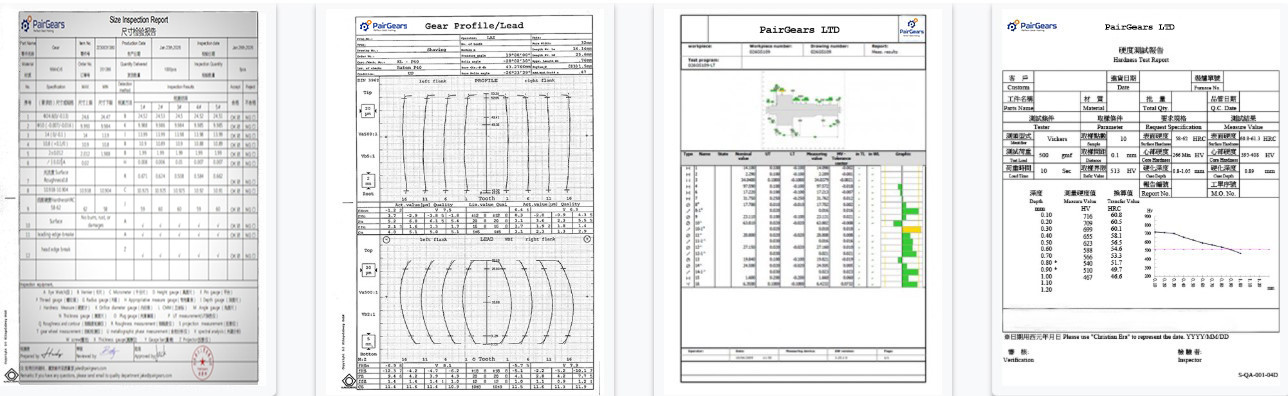
Why Inspection Records and Traceability Matter So Much
At the first-order stage, inspection records mainly prove how that batch performed.
For repeat orders, they become the reference for what later batches should continue to meet.
Without records, batch differences are hard to compare
If a later batch has a problem, and there is no earlier record for comparison, it becomes much harder for both buyer and supplier to judge where the difference began.
With traceability, the problem range becomes smaller
The biggest risk in repeat orders is not one bad part. It is not knowing why one batch is different from the previous one.
With basic batch traceability, the issue can usually be narrowed down to material, heat treatment, inspection, or shipment, instead of being guessed as a whole.
What Repeat-Order Risks Do Buyers Most Often Miss?
Only confirming dimensions, but not confirming the controlled version
Some projects run well in the first batch, so buyers assume later production can simply continue the same way.
But if drawings, samples, and temporary revisions were never organized into one clear controlled version, later batches can easily drift.
Looking only at the sample result, but not the process record
A good sample does not guarantee stable later production.
If material, heat treatment, inspection requirements, and key process points were never fixed into the standard, the supplier may handle later batches according to default habits.
Looking only at unit price, not long-term control
A low first-order price does not always mean lower total cost later.
If repeat batches bring rework, extra inspection, reshipment, or unstable performance, the buyer’s real cost is usually much higher.
Ignoring change control
Many repeat-order problems do not happen because the supplier completely failed. They happen because something changed, but the change was never clearly recorded.
A material substitution, drawing update, packaging change, or tighter schedule can all affect the result.
How Would a Supplier Like PairGears Usually Handle Repeat Orders?
For repeat orders, a more reliable supplier usually does not treat the next batch as "just making more."
It treats the new batch as a continuation of the already confirmed project. If approved samples, drawing versions, inspection records, and material or heat treatment routes have already been set, later batches are easier to keep close to that standard.
If the project originally started from drawings, samples, OEM references, or application information, then later repeat orders depend on whether those records were kept and whether they can be matched to each batch's inspection and shipment records. For buyers who need long-term supply and stable repeat performance, this is usually more important than comparing only the first quotation.
FAQ
Q1: Why are repeat orders harder to evaluate than a first order?
Because a first order mainly shows whether the supplier can make the part. Repeat orders show whether the supplier can keep making it close to the approved sample and standard.
Q2: If the sample was approved, can later batches still become unstable?
Yes. If key sample conditions were not turned into usable production standards, later batches can still drift.
Q3: What inspection data should be stored for repeat orders?
Buyers should keep dimensional inspection results, material certificates, heat treatment records, hardness data, and batch-linked final inspection reports. These records make it easier to compare later batches with the approved standard.
Q4: What kind of supplier is better for long-term repeat orders?
Usually one that can manage drawing versions, keep inspection records, support batch traceability, and carry the approved sample standard into later production.
Q5: What causes repeat order quality variation most often?
The most common missed points are version control, process records, and change control. Many batch problems come not from weak machining ability, but from standards not being carried forward clearly.
Conclusion
A supplier that is suitable for repeat orders is not simply one that can make the first batch. It is one that can carry the approved standard into later production in a stable way.
For buyers, the most useful comparison points are how sample data is locked, how batch records are kept, how material and heat treatment stay consistent, and how project changes are confirmed.
If your project has already moved into batch, or is about to move from sample approval into stable supply, it is often more useful to organize the sample standard, drawing version, inspection requirements, and batch records first than to keep comparing first-order prices. Contact us to send your drawing, sample photos, or OEM number for repeat order review and batch stability check.