How Can Buyers Source Gears for Agricultural Machinery?
- Share
- publisher
- Jessica
- Issue Time
- Jun 15,2026
Summary
Learn how buyers source gears for agricultural machinery, including drawings, samples, OEM numbers, material checks and inspection points before ordering.
Introduction
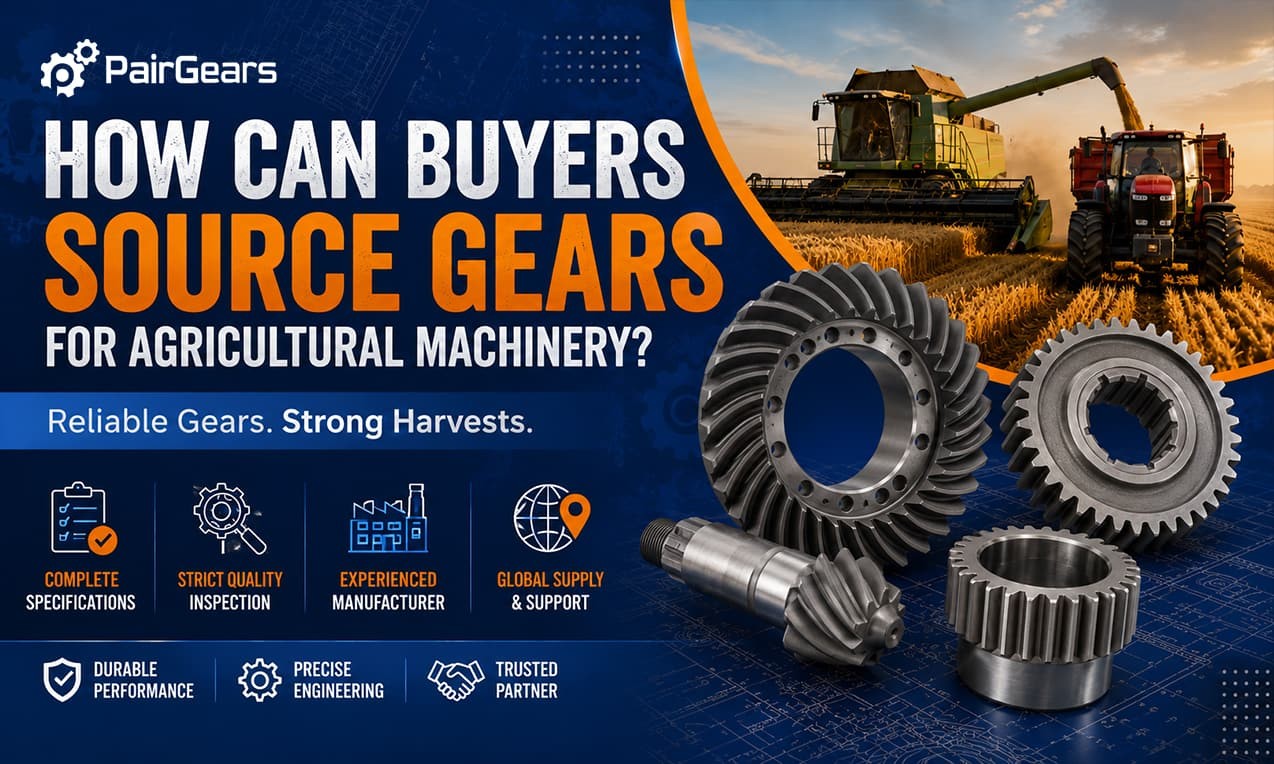
Sourcing gears for agricultural machinery is not only about finding a part that looks similar. Buyers need to confirm the machine application, part number, drawing details, sample condition, material, heat treatment, tooth geometry, inspection requirements, and delivery plan before placing an order.
At PairGears, we manufacture custom precision gears and gear sets for Agricultural Machinery, Heavy-Duty Trucks, Construction Equipment, and EV drivetrains. For agricultural gear projects, the real question is not only whether the gear can be made. The more important question is whether it can be matched, manufactured, and inspected correctly for the real working conditions of the machine.
What are gears for agricultural machinery?
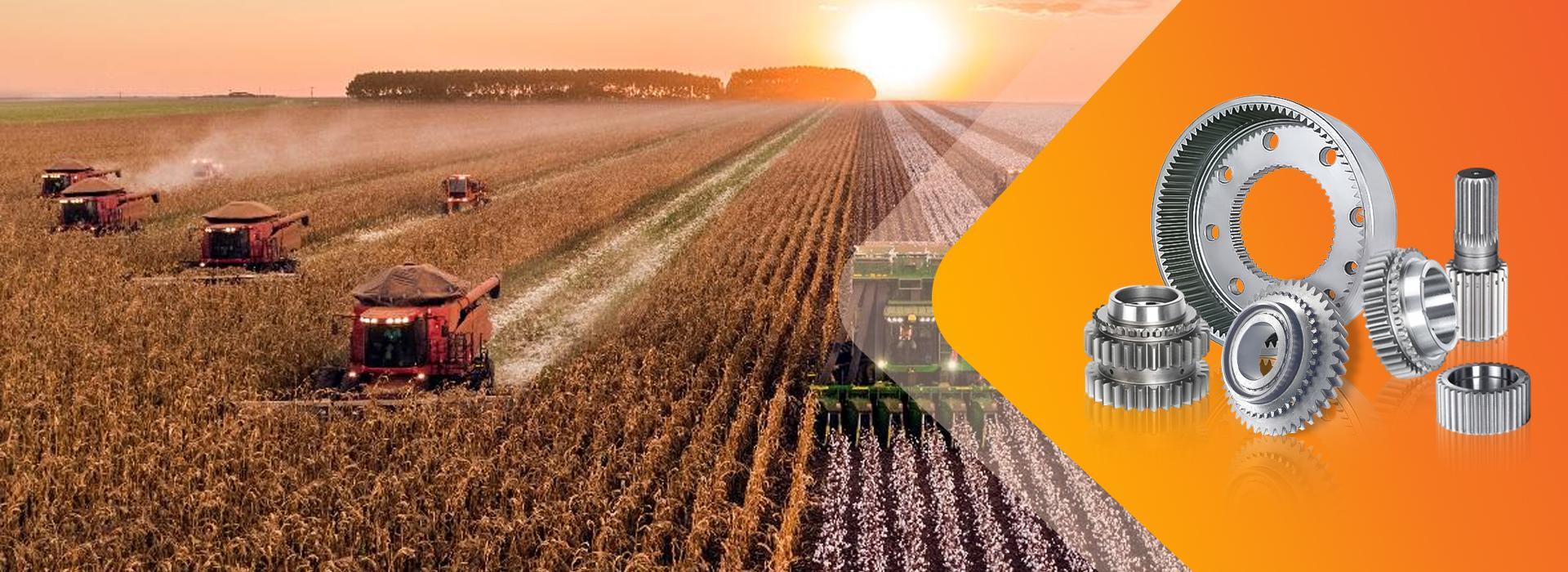
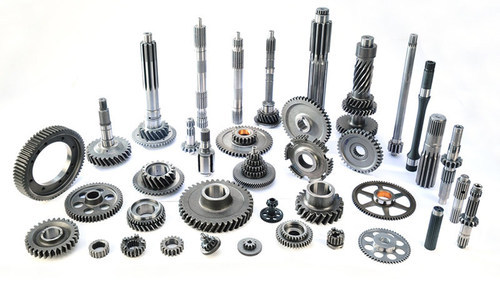
Gears for agricultural machinery are transmission parts used in tractors, harvesters, seeders, feed mixers, and other field equipment to transfer torque, change speed, change direction, or support final-drive movement.
Why sourcing gears for agricultural machinery needs extra review
Agricultural machinery does not usually work in clean, stable, indoor conditions. It often runs in dust, mud, moisture, vibration, impact, and uneven field load. That means a gear that looks simple from the outside may still need careful review of tooth profile, hardness, bore fit, spline details, and mating condition before it can be replaced correctly.
Downtime is also more expensive in agriculture than many buyers first expect. If a tractor, harvester, or seeder stops during planting or harvest season, the buyer is not only replacing a part. They may also be losing working time, field efficiency, and delivery schedules. That is why the sourcing process should be treated as a technical review, not only a price check.
Another challenge is that many agricultural replacement projects involve older machines. The original drawing may be missing, the OEM number may be incomplete, and the old sample may already be worn. In those cases, the supplier must be able to review photos, measure critical dimensions, understand mating logic, and judge whether the worn part still reflects the original design.
What buyers should send when sourcing gears for agricultural machinery
The more complete the information is, the easier it becomes to judge whether the part can be manufactured and matched correctly.
| Information to send | Why it matters | Buyer note |
| Drawing or 2D/3D file | Confirms dimensions, tolerances, tooth data, and structure | Best starting point for custom production |
| OEM number or part number | Helps identify the original replacement direction | Useful, but should not be used alone |
| Clear sample photos | Shows tooth form, bore, spline, keyway, chamfer, and wear | Send multiple angles |
Machine model and application | Helps review load and working environment | Tractor, harvester, seeder, mixer, etc. |
Tooth count and outside diameter | Useful when no drawing is available | Measure carefully if the sample is worn |
Bore, spline, or keyway details | Helps avoid assembly mismatch | Often the main source of wrong orders |
Material and hardness data | Affects strength, wear resistance, and cost | Old reports are helpful if available |
Heat treatment requirement | Controls surface hardness and service life | Should be reviewed together with material |
Quantity and delivery target | Affects tooling, cost, and planning | Important for both samples and batch orders |
If the information is incomplete, it is still better to start with what you have. A supplier can review the available data first and then advise what else should be confirmed before quotation or sample production.
Which buyers need agricultural machinery gears sourcing support?
● Agricultural Machinery buyers
Many field machines stay in service for years, so replacement gears often come from worn samples, old part numbers, or incomplete records.
● Repair and maintenance teams
They often work under time pressure, which increases the risk of ordering a gear that looks correct but does not actually fit or mesh properly.
● Aftermarket distributors
They need more than part-number matching. They also need to confirm geometry, fit, and repeatability for future orders.
● OEM and custom project buyers
Even if the gear is not a repair part, early confirmation of tooth data, material, and inspection scope can avoid repeated revisions later.
What should buyers confirm before ordering agricultural machinery gears?
Before buyers place an order, the supplier should review more than the basic size of the part. The goal is to confirm whether the new gear can fit, mesh, and work reliably in the agricultural machine.
The most important points to review
● Tooth geometry
Tooth count, module or DP, pressure angle, helix angle, and hand direction should be confirmed whenever possible. These values define whether the replacement can really mesh with the existing mating gear.
● Main fit dimensions
Outside diameter is not enough. Bore size, spline form, keyway, face width, shoulder position, and total length all affect installation and working fit.
● Material and heat treatment
Agricultural gears often work under repeated load and contamination, so the material route and hardness condition matter as much as the visible shape.
● Mating part relationship
A correct new gear may still fail early if the mating gear, shaft, bearing, or housing is already worn or unstable.
● Application load and service condition
A gear for a light feeder system is not judged the same way as a gear in a tractor transmission or final drive. The working condition should always be explained clearly.
Practical note on old samples
An old sample is useful, but it should not always be treated as a perfect reverse-engineering source. Tooth wear, pitting, broken corners, or spline damage may have already changed the original part condition. That is why drawings, OEM numbers, and mating part information are so helpful when available.
Practical note on OEM numbers
OEM numbers are helpful, but they are rarely enough by themselves. In practice, a number works best when it is matched with machine model, sample photos, and key dimensions. That extra confirmation is often what prevents wrong agricultural gear orders.
How better sourcing information reduces wrong agricultural gear orders
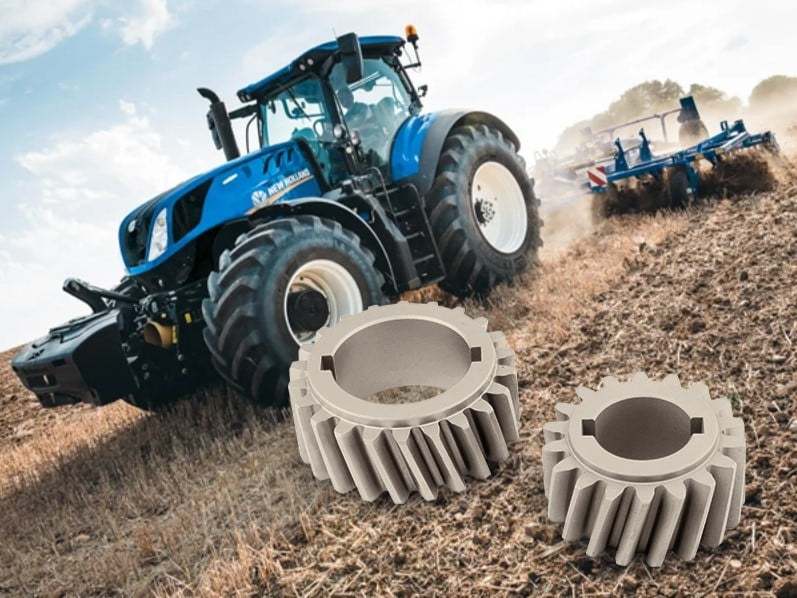
Better sourcing information does more than speed up quotation. It reduces the chance of wrong matching, repeated sampling, or receiving a gear that cannot be used in the busy season.
A better RFQ usually leads to:
◆ a more accurate quote
◆ a clearer process route
◆ better matching with the mating part
◆ fewer sample revisions
◆ lower risk of installation problems
◆ more stable repeat production
For buyers, the real benefit is lower ordering risk. Clear information helps the supplier review the part before production instead of discovering problems after the sample or shipment arrives.
Practical buyer tips before sending an RFQ
● Send the drawing first if you have it.
A clear drawing is still the fastest way to reduce confusion.
● If no drawing is available, send the sample and multiple photos.
Include front, back, side, bore, spline, and damage-area images if possible.
● Do not separate material from heat treatment.
These two should always be reviewed together because they define how the gear will really perform.
● Explain the machine and the working condition.
Field load, shock, dirt, and service environment all matter for agricultural gears.
● State inspection requirements early.
If you need hardness reports, dimensional reports, or material certificates, it is better to define that before the quote is finalized.
Why Choose PairGears
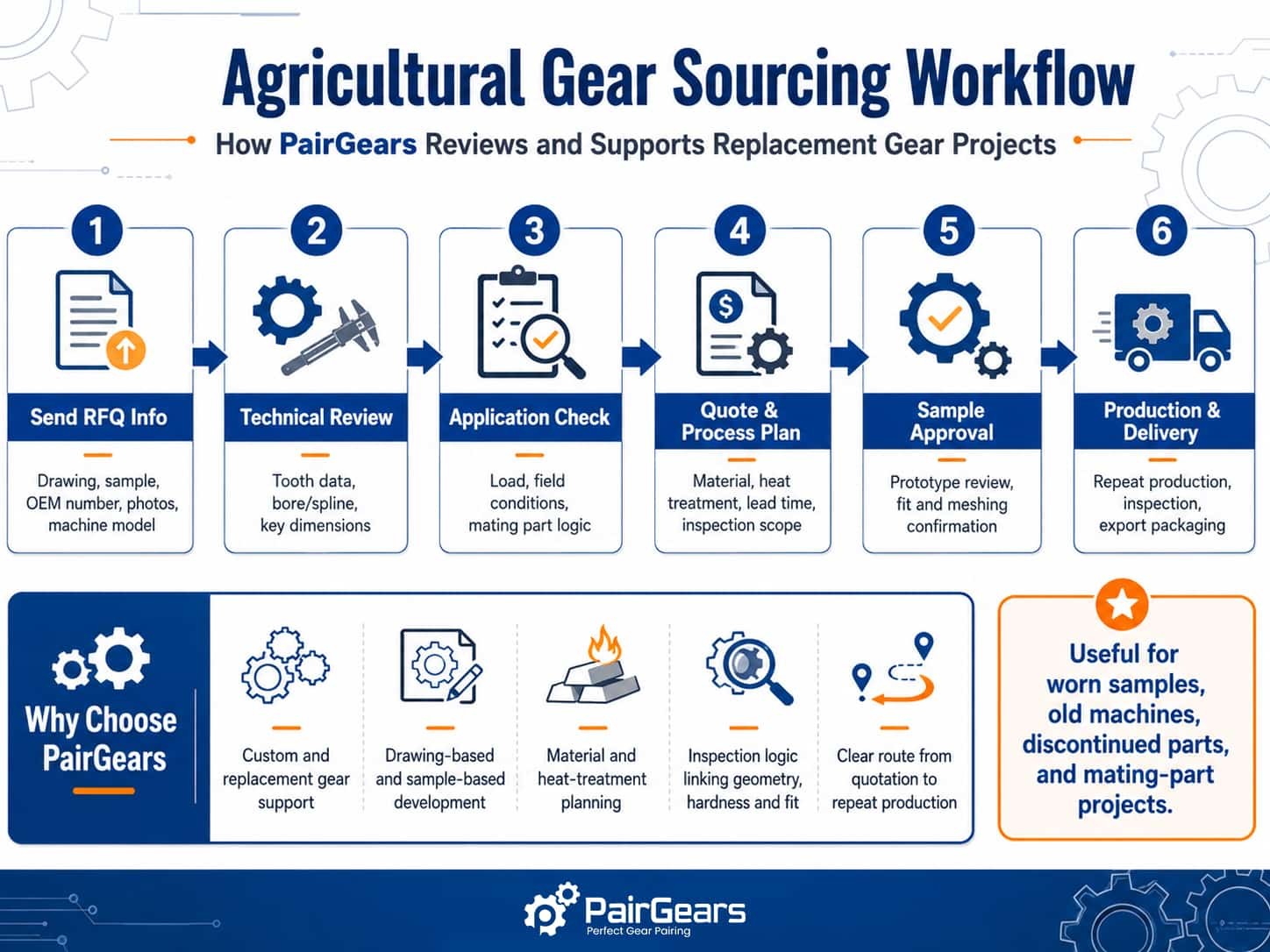
PairGears supports custom gear and replacement gear projects from drawings, samples, OEM numbers, photos, and application details. For agricultural gear sourcing, we do not only look at the visible gear shape. We review the working logic behind the part, including tooth data, material, heat treatment, mating condition, and inspection scope.
What we focus on:
◆ practical review for Agricultural Machinery and other heavy-duty transmission sectors
◆ drawing-based and sample-based custom gear development
◆ material and heat-treatment planning based on real field service conditions
◆ inspection logic that connects geometry, hardness, and fit
◆ workable routes from quotation to sample approval and repeat production
This kind of early review is especially useful when the project involves worn samples, old machines, discontinued parts, or gears that must match an existing mating part in service.
FAQ
Q1: Can I get a quote without a drawing?
Yes. A sample, OEM number, product photo, or key dimensions can still help start the review, although more technical confirmation may be needed later.
Q2: What is the most important information in an agricultural gear RFQ?
A drawing is usually the best starting point, followed by tooth data, machine model, material, heat treatment, and application details.
Q3: Why is machine model important if I already have the gear photo?
Because the same-looking gear may be used in different machines with different load and fit requirements.
Q4: Should I send the mating gear too?
If possible, yes. That is especially useful when backlash, contact pattern, and matching are important.
Q5: Can PairGears work from samples or OEM numbers?
Yes. Projects can start from drawings, samples, OEM numbers, photos, and application information.
Conclusion
Sourcing gears for agricultural machinery should not be treated as a simple visual replacement job. The part may look familiar, but correct sourcing depends on tooth data, fit dimensions, material, heat treatment, mating condition, and the real field environment of the machine.
If you are preparing an RFQ for gears for agricultural machinery, you are welcome to Contact Us with your drawings, samples, OEM numbers, photos, and machine details so PairGears can help review the project and discuss a practical quotation, manufacturing, and inspection plan.