Diametral Pitch vs Module: How to Avoid Gear Mismatch
- Share
- publisher
- PairGears
- Issue Time
- Sep 1,2026
Summary
Learn the difference between diametral pitch and module, whether metric gears can replace imperial gears, and what to check to avoid gear mismatch.
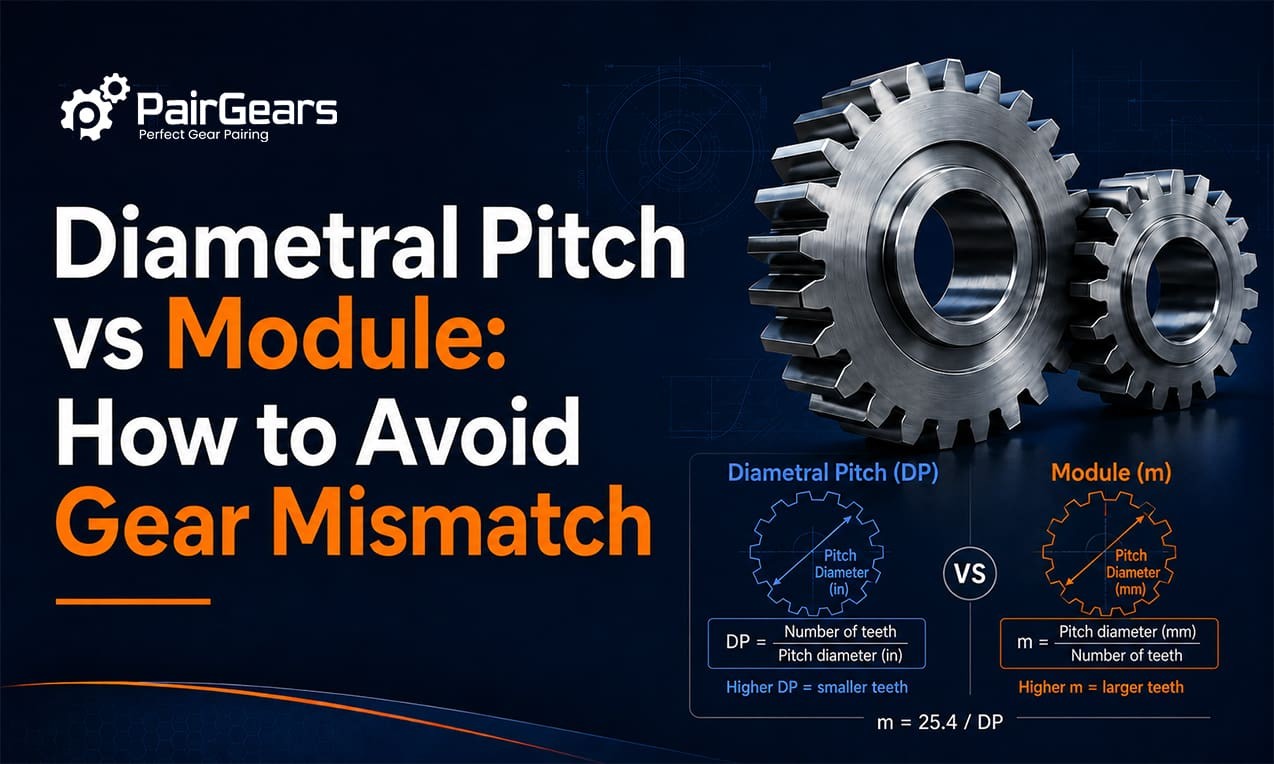
In old-machine repair, gear replacement sourcing, and drawing conversion between different countries, diametral pitch (DP) and module may appear in the same project. DP is common in older North American drawings, while module is widely used in metric markets.
A 10 DP gear converts to Module 2.54, but that does not mean it can be replaced with a standard Module 2.5 gear. Unit conversion does not confirm interchangeability. For buyers looking for a precision gear manufacturer, pressure angle, tooth count, pitch diameter, tooth thickness, profile shift, helix angle and mating gear condition may still need to be checked.
What Is the Difference Between Diametral Pitch and Module?
Diametral pitch and module both describe gear tooth size, but they use different measurement systems and opposite numerical relationships.
| Comparison | Module | Diametral Pitch |
|---|---|---|
| Measurement system | Metric | Imperial |
| Basic definition | Pitch diameter ÷ number of teeth | Number of teeth ÷ pitch diameter |
| Typical unit | mm | teeth/inch |
| As the value increases | Teeth become larger | Teeth become smaller |
| Common use | Europe, Asia, and other metric markets | North America and some older equipment |
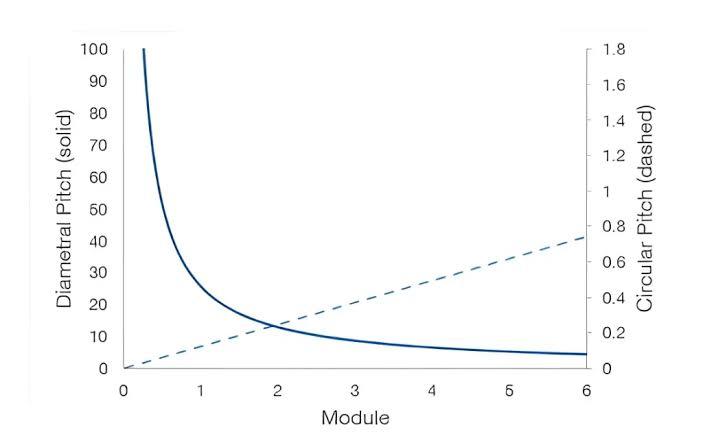
| Conversion | m = 25.4 / DP | DP = 25.4 / m |
For example, a Module 4 gear normally has larger teeth than a Module 2 gear. In the DP system, however, an 8 DP gear has larger teeth than a 16 DP gear.
This opposite relationship is one reason buyers can misread old drawings or replacement gear specifications when they focus only on the number.
How Do You Convert Diametral Pitch to Module?
For example: 10 DP = 25.4 ÷ 10 = Module 2.54.
The calculation is simple, but it only converts one gear tooth-size system into another. It does not tell you whether two standard gears can be used interchangeably.
For example, 10 DP corresponds exactly to Module 2.54, but that does not mean a standard Module 2.5 gear will automatically replace the original 10 DP gear.
For more detailed DP calculations, outside-diameter estimation, and module conversion, see our guide on Diametral Pitch DP Formula and Module Conversion.
Why Can DP-to-Module Conversion Still Cause Gear Mismatch?
One common mistake is treating an exact converted value as if it can be rounded to the nearest standard module size.
| Original Specification | Exact Module Equivalent | Common Wrong Assumption |
|---|---|---|
| 8 DP | 3.175 | Replace with Module 3 |
| 10 DP | 2.540 | Replace with Module 2.5 |
| 12 DP | 2.117 | Replace with Module 2 |
| 16 DP | 1.588 | Select a nearby standard module |
The numerical difference may look small, but in an existing transmission with fixed center distance and mating gear, changing tooth size may affect pitch diameter, tooth thickness, backlash, tooth contact and gear meshing. A correct DP-to-module conversion does not automatically make two gears interchangeable.
For a new gear pair, module, tooth count and center distance may be recalculated together. But for a replacement gear, the surrounding geometry is already fixed, so rounding the converted value to a nearby standard module may still create a mismatch.
Can a Metric Gear Replace an Imperial Gear?
Yes, but only if the original gear geometry and mating conditions are correctly maintained.
Replacing DP With a Nearby Standard Module
Suppose the original gear is 10 DP = Module 2.54. If the gear is changed to standard Module 2.5, the basic tooth size is no longer identical to the original gear.
The fact that 2.5 and 2.54 are numerically close is not enough to confirm interchangeability.
Expressing the Original Imperial Gear in Metric Units
This is different. A supplier may use millimeters for drawing, measurement, and dimensional control without changing the original gear into a standard metric module design.
If the original tooth pitch relationship, pressure angle, tooth count, pitch diameter, tooth profile, and mating conditions are preserved, expressing dimensions in metric units does not change how the gear functions.
What must be preserved is not the label “DP” or “module,” but the actual gear geometry and meshing relationship.
What Must Match Besides DP or Module?
DP or module is only the first step. Even if two gears have the same module, or if the DP-to-module conversion is exact, they are not automatically guaranteed to mesh correctly.
For example, two gears can have the same module and still fail to mesh correctly if their pressure angles, profile shifts, or mating conditions are different. A better question is not only “What is the module?” but “What geometry must be reproduced for the replacement gear to work with the existing mating gear?”
For related meshing checks, see Same Module Gears Still Not Meshing? What to Check.
What Commonly Causes Gear Mismatch in Replacement Projects?
In many replacement projects, the problem is not the DP or module formula itself. The problem is that the gear specification is confirmed too early, before enough information has been collected.
Choosing the Nearest Standard Module
Module 2.54 and Module 2.5 may look close, but “close” is not the same as compatible. The difference should be checked against the existing gear pair and installation conditions.
Ignoring the Pressure Angle
The same DP or module does not guarantee the same pressure angle. This is especially important with older machinery and historical drawings, where tooth count and outside diameter alone may not identify the original geometry.
Measuring a Heavily Worn Gear Directly
An old gear may already have flank wear, pitting, worn tooth tips, deformation, or damaged teeth. Measurements taken from the worn part may differ from the original design. A used gear is useful reference data, but the difference between original geometry and current worn geometry must be considered.
Checking Only One Gear
Gears operate as a pair. If the mating gear, center distance, or installation information is unavailable, some parameters may have to be inferred rather than confirmed.
Identifying the Gear Only From Outside Diameter
Outside diameter can help estimate a gear specification, but it should not be treated as the only production reference. Profile-shifted gears, worn gears, and special tooth designs may produce misleading results if OD is used alone.
What Should Buyers Check Before Ordering a Replacement Gear?
For projects involving metric and imperial gear systems, a structured review can reduce the risk of ordering the wrong replacement.
Review Existing Information
Collect as much original information as possible, including the original drawing, OEM part number, old gear sample, mating gear, installation photos, and original equipment information.
Confirm the Gear Geometry
Besides DP or module, buyers should check tooth count, pressure angle, pitch diameter, helix angle, tooth thickness, profile shift, bore, spline, keyway, and center distance. A single DP or module value is not enough for a complete replacement assessment.
Check the Mating Gear
If only one gear is being replaced, the specification and wear condition of the existing mating gear should be reviewed whenever possible. This is especially important for older equipment.
Prototype Before Production
When the drawing is incomplete, the sample is heavily worn, or some geometry remains uncertain, prototype verification may be safer than moving directly into batch production. During the sample stage, key dimensions, tooth geometry, and actual assembly conditions can be checked before final approval.
What Information Should You Provide If the Original Drawing Is Missing?
A replacement gear project may still be possible even when the original drawing is no longer available.
Useful information includes:
- old gear sample;
- clear photos from multiple angles;
- OEM part number;
- tooth count;
- outside diameter and key installation dimensions;
- mating gear photos or sample;
- machine model;
- application position;
- required quantity.
If center distance, transmission ratio, or partial original drawings are also available, they can help confirm the original design. For a heavily worn gear, mating gear information becomes particularly valuable.
How Does PairGears Review DP and Module Replacement Projects?
For projects involving diametral pitch, module, or older equipment replacement gears, PairGears reviews the available information to confirm which gear geometry and installation relationships must be preserved. The project should not rely on one converted value alone.
The review may include original gear parameters, installation dimensions, mating conditions, material, heat treatment, inspection requirements and possible prototype verification. If only an old sample, photos or an OEM number is available, the project can first be reviewed based on the existing information, followed by clarification of any missing data.
For metric-to-imperial or imperial-to-metric projects, the key question is not simply “How do we convert the units?” It is: Will the converted specification still preserve the original meshing and installation relationship?
FAQ
Are diametral pitch and module the same thing?
No. Both describe gear tooth size, but they use different systems. Module is metric, while diametral pitch is imperial.
How do you convert DP to module?
The basic formula is Module = 25.4 ÷ DP. This converts the unit only; it does not prove that two gears are interchangeable.
Can 10 DP be replaced directly with Module 2.5?
No. 10 DP equals Module 2.54, while Module 2.5 is a different tooth size. The full gear geometry and mating conditions should be checked first.
Can a metric gear mesh with an imperial gear?
Yes, if the tooth pitch, pressure angle, tooth profile and mating conditions are compatible. The unit system alone does not decide whether two gears can mesh.
How can you identify whether an old gear uses module or DP without a drawing?
Tooth count, outside diameter and tooth geometry can support an initial review. For worn or special gears, check the old sample together with photos, mating gear data and the OEM part number.
Conclusion
The mathematical conversion between DP and module is simple. The more important question is whether the converted parameters still preserve the original machine’s meshing and installation conditions.
Convert the Units, Preserve the Gear Geometry
If you are sourcing a metric or imperial replacement gear, or if you only have an old gear sample, photos, or an OEM number, you can contact us with the available information for a technical review and quotation.