Common Gear Terms and What They Mean
- Share
- publisher
- Jessica
- Issue Time
- Mar 31,2026
Summary
Gear terminology affects drawings, meshing, sourcing, and inspection. This guide explains the main gear terms and what they mean in practical engineering work

1. Introduction
In many gear projects, problems do not start with machining. They start much earlier, when basic terms are misunderstood. A drawing may list module, pitch circle, pressure angle, backlash, or base circle, but not everyone in the project interprets those terms the same way. That is often where mismatch, rework, and sourcing delays begin.
At PairGears, we manufacture custom precision gears and gear sets for Agricultural Machinery, Heavy Truck, Construction Equipment, and EV drivetrains. In real factory communication, gear terminology is not just theory. It shapes how drawings are reviewed, how parts are quoted, how mating gears are checked, and how assembly and inspection decisions are made. This guide explains the most common gear terms and why they matter in practical work.
2. What are gear terms?
Gear terms are the standard technical words used to describe gear geometry, meshing relationships, size references, and inspection-related features.
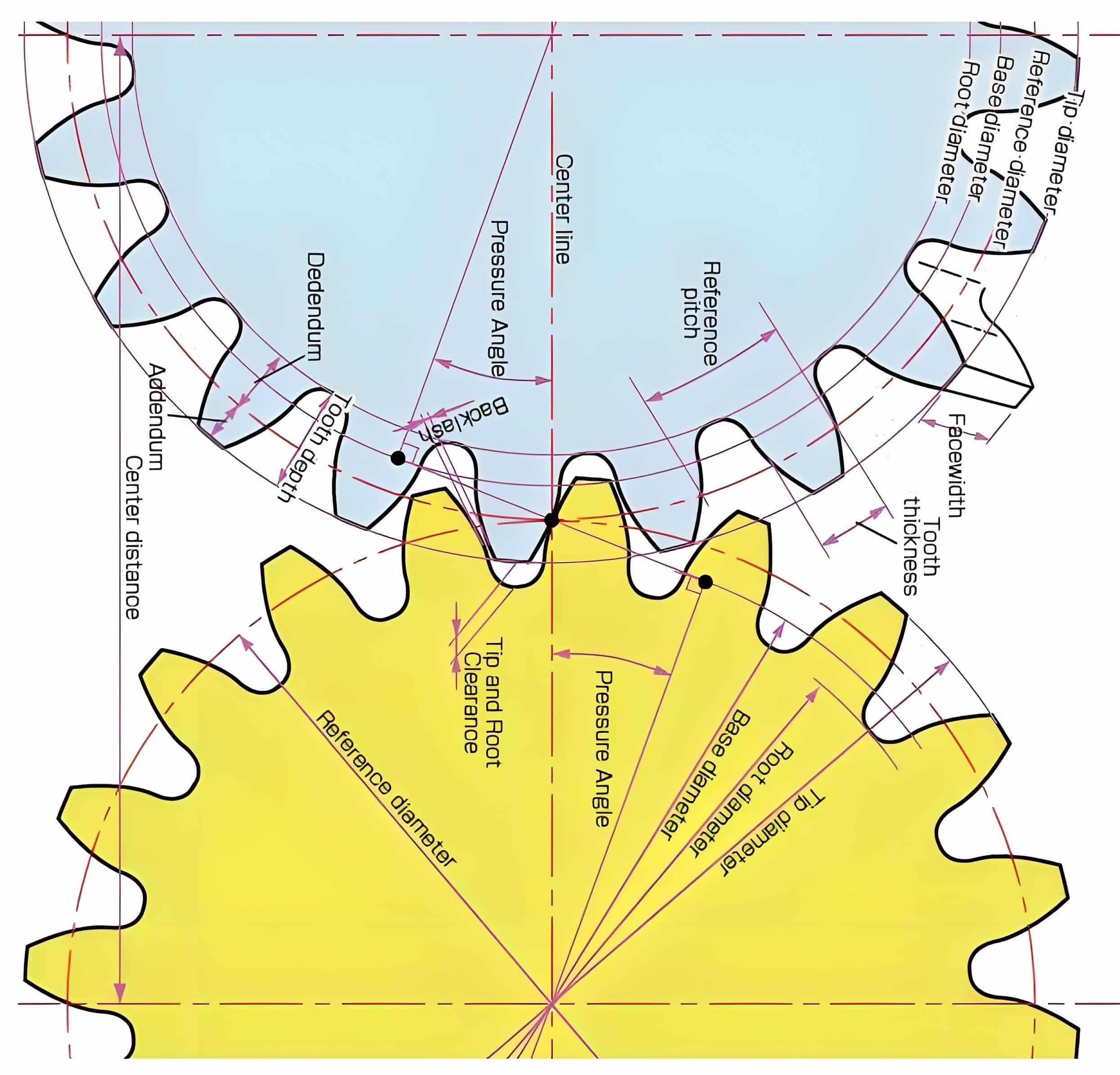
3. Why gear terminology matters in real projects
Gear terminology matters because a gear is not defined by tooth count alone. A drawing may look complete, but if the team does not clearly distinguish terms such as pitch circle, base circle, module, addendum, dedendum, or backlash, wrong design, production, or sourcing decisions can still happen.
This becomes even more important in supplier communication. Many delays come not from poor quality, but from inconsistent terminology. One person may say pitch and mean circular pitch, while another assumes diametral pitch. Someone may refer to gear size but actually mean pitch diameter, outside diameter, or center distance. Once that confusion enters an RFQ, inspection plan, or spare-part order, the project becomes slower and more expensive.
Terminology also affects troubleshooting and production control. If a team does not separate backlash from fit clearance, or design references from acceptance items, it may chase the wrong problem or measure the wrong feature. That is why experienced teams treat gear terms as both a design tool and a communication tool: clear terminology shortens RFQ cycles, improves drawing review, and reduces the risk of ordering the wrong part.
4. Main groups of gear terms in practical work
| Term group | Typical terms | What they describe | Why they matter |
| Tooth size terms | module, diametral pitch, circular pitch | How large or fine the teeth are | Affects meshing compatibility, strength, and tooling |
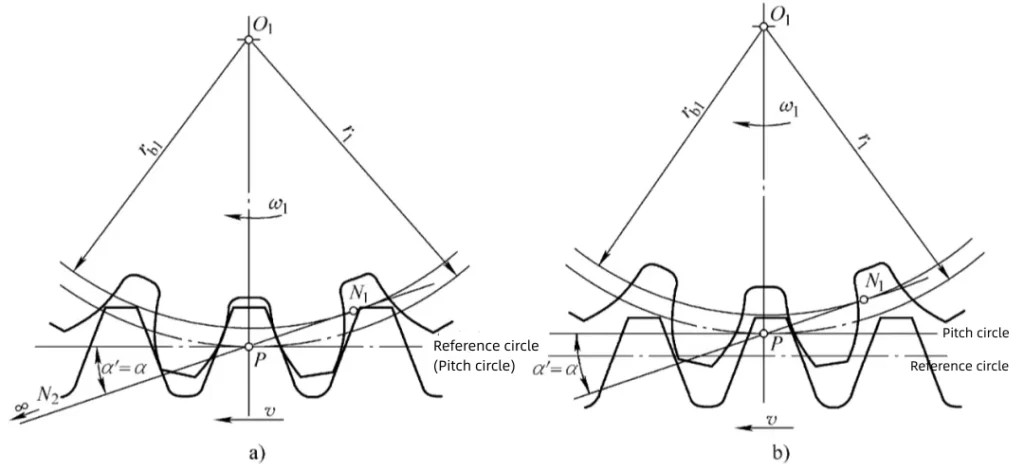
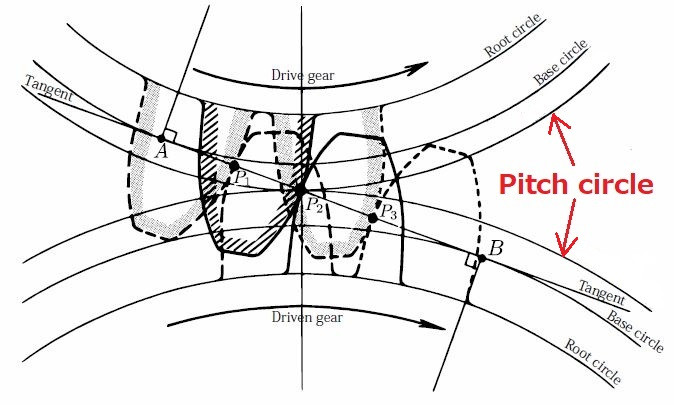
| Reference circles | pitch circle, base circle, addendum circle, root circle | The geometric circles used to define size and tooth form | Essential for calculation, geometry review, and interpretation of drawings |
Tooth form terms | pressure angle, involute profile, tooth thickness | How the tooth shape is built and how teeth meet | Affects contact behavior, load direction, and interchangeability |
Meshing and clearance terms | backlash, center distance, contact ratio | How two gears engage in service | Directly influences noise, feel, temperature, and life |
These groups help because many misunderstandings come from mixing terms that belong to different parts of the design logic. For example, module is a tooth-size term, while pitch circle is a reference-circle term. They are linked, but they are not interchangeable.
In most RFQs, you do not need to explain the full geometry history of a gear. You do need to make sure the project uses the same language for tooth size, reference circles, and meshing conditions from the beginning.
5. Where terminology mistakes matter most
● Agricultural Machinery
Long duty cycles, contamination, and frequent spare-part replacement make it important to describe gears correctly and avoid mismatch during maintenance or procurement.
● Heavy Truck
High torque density and long-life expectations mean that tooth geometry, center distance, backlash, and pressure angle must all be understood consistently.
● Construction Equipment
Shock loads and harsh environments make wrong gear terminology especially expensive because replacement delays and installation errors quickly affect uptime.
● EV Drivetrains
In higher-speed, tighter-tolerance systems, terminology clarity is critical because small misunderstandings can cause larger problems in noise, efficiency, and repeatability.
6. The core terms engineers and buyers should check first
| Check item | What to confirm | Why it matters |
| Module or DP system | Metric module or diametral pitch | Defines the tooth size system and basic compatibility |
| Pitch circle reference | Whether the size discussion uses pitch circle or OD | Prevents wrong calculations and wrong replacement choices |
Pressure angle | 20°, 14.5°, or other specified value | Must match for correct meshing |
Tooth count | Number of teeth | Affects ratio, pitch relationships, and size |
| Backlash target | Required running clearance | Helps avoid binding or excessive looseness |
Center distance | Nominal and actual shaft spacing | Directly affects meshing behavior |
Tooth thickness / tooth space | Functional fit at the reference circle | Influences backlash, contact, and repeatability |
Base circle relevance | Whether the design uses involute geometry | Helps explain tooth-form logic and meshing analysis |
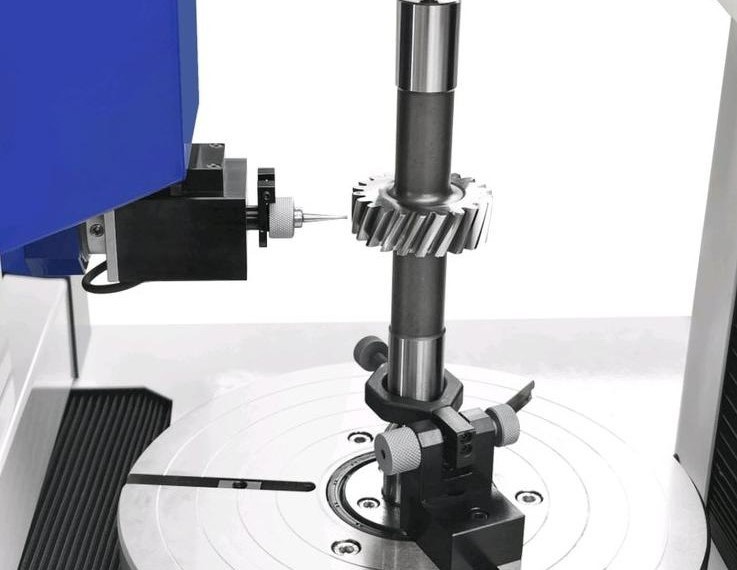
Not every term needs to be measured directly in production. Some, like the base circle, are more important as design and analysis references than as visible shop-floor dimensions. Others, like backlash, runout, center distance, or tooth thickness, are directly tied to assembly and performance. The key is to know which terms are functional inspection items and which are supporting geometry concepts.
A practical review usually starts with a simple question: which of these terms determines whether the gear will actually fit and run correctly in the assembly? That question helps teams avoid overchecking abstract geometry while underchecking the parameters that control performance.
7. What good terminology control improves
| Benefit | What becomes easier | Practical result |
Drawing review | Teams talk about the same geometry references | Faster RFQ and fewer clarification loops |
Meshing analysis | Pitch, pressure angle, and tooth form are understood correctly | Better matching and less trial-and-error |
| Sourcing accuracy | Buyers can compare like-for-like parts | Lower risk of wrong-part procurement |
| Inspection logic | Functional terms are separated from pure design references | More useful acceptance criteria |
| Troubleshooting speed | Complaints can be linked to the right cause | Less wasted effort in root-cause analysis |
In other words, terminology is not just for understanding the theory. It directly improves communication quality, which is one of the fastest ways to reduce manufacturing and sourcing errors.
Good terminology control also helps during change management. When a drawing revision changes module, pressure angle, or backlash, a team that uses precise terms can quickly see what else may be affected—tooling, meshing, inspection, or service parts. That makes engineering changes easier to manage and less risky to release.
8. Practical Gear Term Checks with Suppliers
● Start by confirming the tooth system. Ask whether the project is defined by metric module or diametral pitch, and make sure both sides use the same system throughout the RFQ and drawing review.
● Clarify which circle is being referenced. When discussing diameter, pitch, tooth thickness, or clearance, confirm whether the reference is the pitch circle, addendum circle, or another geometry.
● Confirm pressure angle together with tooth size. Module or DP alone is not enough for correct meshing. Pressure angle and tooth form must match as well.
● Separate design references from functional checks. Terms such as base circle are important for geometry understanding, but they are not the same as acceptance checks like backlash, runout, or center distance.
● Use terminology clarity as a supplier communication test. A supplier that can explain these terms clearly is usually easier to work with when the project becomes more complex.
This section is practical on purpose. In most real RFQs, you do not need to debate every gear formula. You need to make sure the project uses the same language from the beginning. That alone can remove a large share of avoidable quoting, inspection, and replacement mistakes.
9. Why Choose Us
At PairGears, we connect gear terminology to real production and application work rather than leaving it at the textbook level.
●translating drawings and terminology into manufacturable and inspectable requirements
●supporting Agricultural Machinery, Heavy Truck, Construction Equipment, and EV drivetrains
●helping customers distinguish between design references and real acceptance checks
●reviewing gear parameters with attention to meshing logic, not only nominal size
●supporting projects from early RFQ clarification through repeat production
For many customers, the value is not only in making the part. It is in making sure everyone understands the same part before manufacturing starts.
10. FAQ
Q1: Is The Pitch Circle The Same As The Outside Diameter?
No. The pitch circle is a design and meshing reference. The outside diameter is the visible outer limit of the gear.
Q2: Is The Base Circle The Same As The Pitch Circle?
No. The base circle is the reference used to generate the involute tooth form, while the pitch circle is used for ratio and basic size relationships.
Q3: Why Is Pressure Angle So Important?
Because it affects tooth contact direction and must match between mating gears for correct meshing.
Q4: Is Backlash A Problem Or A Requirement?
Backlash is a necessary clearance in most gear systems. The issue is not whether it exists, but whether it is controlled properly.
Q5: Why do buyers need to know these terms?
Because wrong terminology often causes wrong RFQs, wrong spare-part assumptions, and avoidable delays in sourcing and assembly.
11. Conclusion
Gear terminology may look basic, but it is one of the foundations of successful gear projects. Terms such as module, pitch circle, base circle, pressure angle, backlash, and center distance directly affect how teams understand drawings, compare suppliers, verify meshing, and replace parts in service.
If you are reviewing a gear drawing, preparing an RFQ, or trying to clarify whether a gear parameter is being interpreted correctly, you are welcome to Contact Us with your drawings, parameter list, or operating conditions so we can help turn terminology into a practical manufacturing and inspection discussion.