Advantages and Disadvantages of Bevel Gears
- Share
- publisher
- Jessica
- Issue Time
- Feb 24,2026
Summary
Bevel gears transmit torque between intersecting shafts. This guide covers advantages, disadvantages, and selection for heavy-duty transmission systems.
1. Introduction
Bevel gears are widely used in transmission systems where torque must be transferred between intersecting shafts, typically at 90 degrees. They are common in agricultural machinery, heavy-duty truck differentials, construction equipment, and EV reduction systems that require compact layouts and directional power flow. Their conical geometry enables efficient right-angle transmission under high torque conditions.
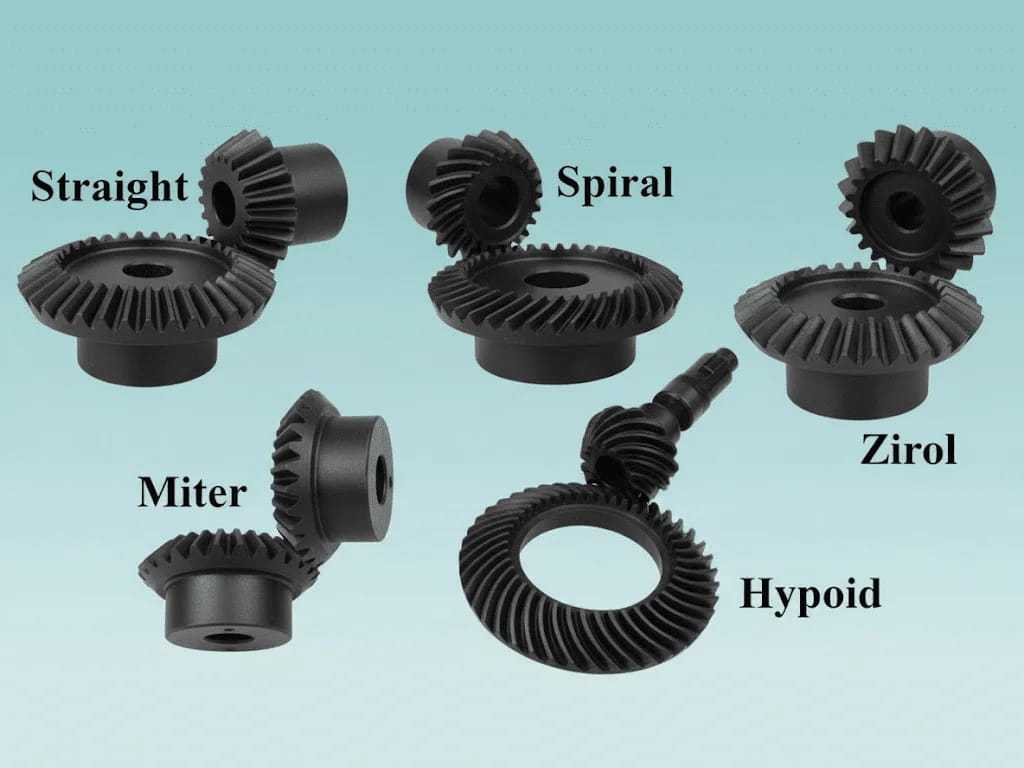
At PairGears, we manufacture precision bevel gears for heavy-duty applications, including straight, spiral, zerol, and hypoid types. While bevel gears provide structural advantages in compact drivetrains, they also introduce axial forces, lubrication sensitivity, and matched-pair requirements. Understanding these factors is essential when evaluating bevel gear performance in high-load systems.
2. What are bevel gears
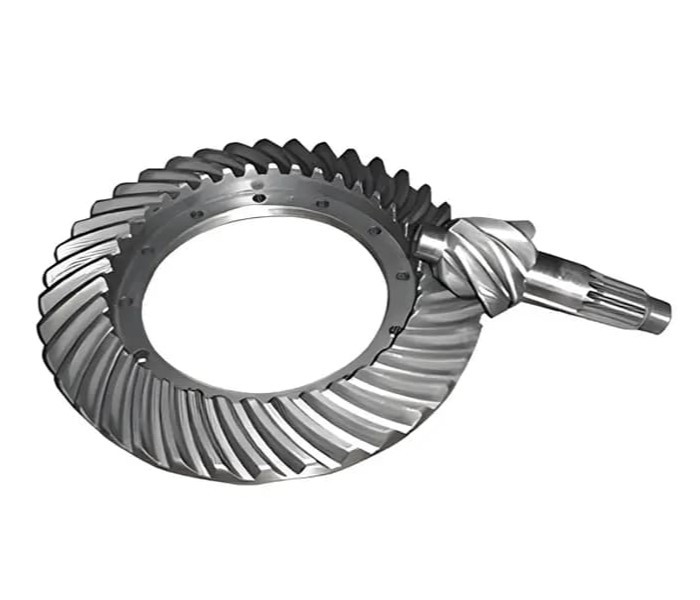
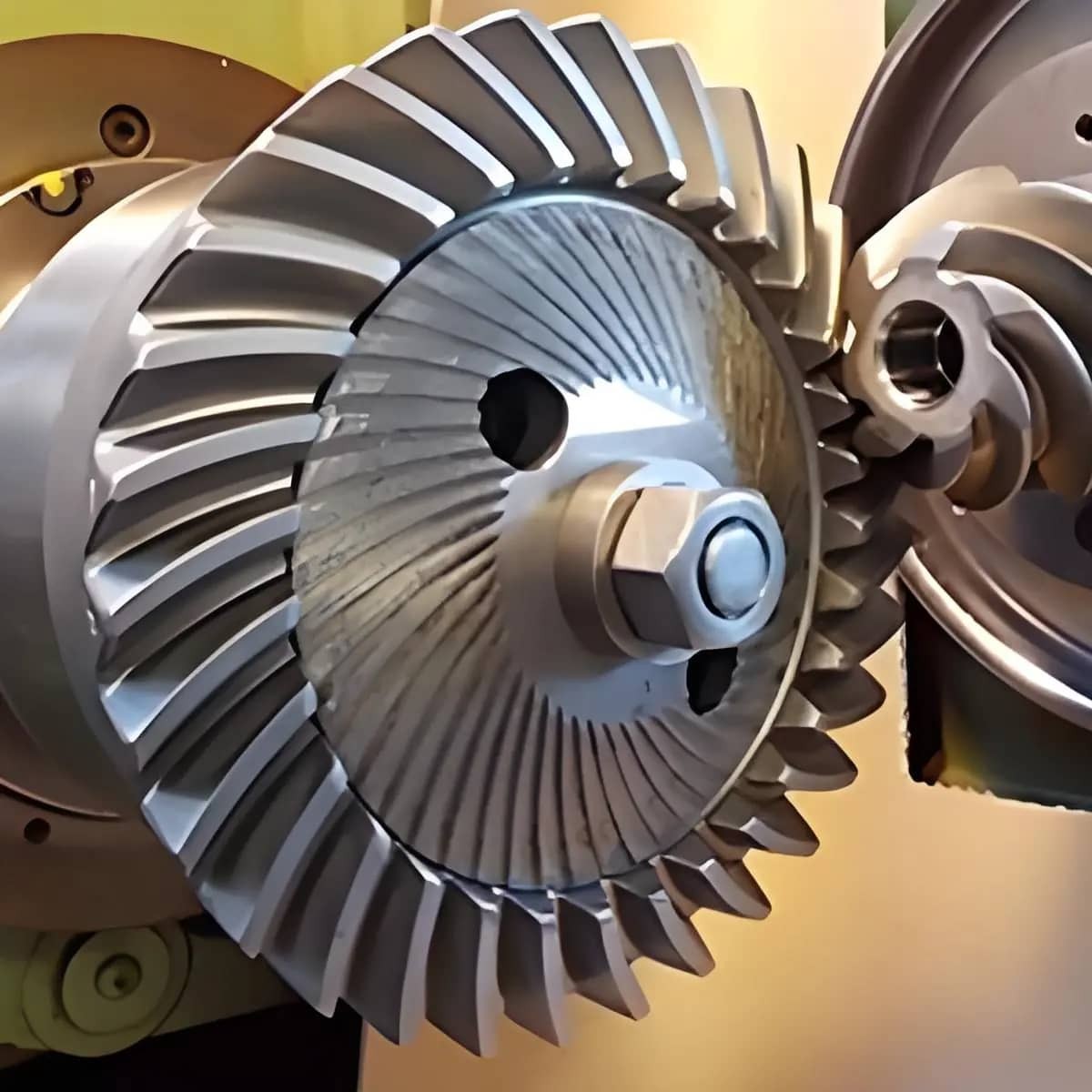
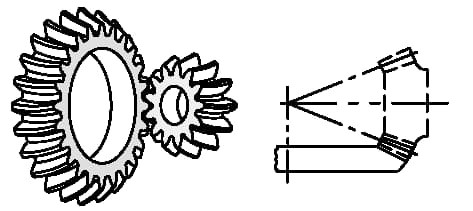
Bevel gears are gears whose teeth are cut on conical surfaces. They are primarily used to transmit motion and torque between intersecting shafts. Power is transferred through controlled meshing of tapered teeth, allowing both speed conversion and directional change.
Unlike cylindrical gears, bevel gears operate in angular shaft configurations. Their geometry directly influences contact patterns, load distribution, axial force generation, and lubrication behavior. Therefore, design accuracy and installation control are critical to performance stability.
3. Overall advantages of bevel gears
| Advantage | Engineering Meaning | Practical Impact |
| Direction change capability | Transfers torque between intersecting shafts | Enables compact 90° transmission systems |
| High transmission efficiency | Single-stage efficiency up to 97–98% | Reduces energy loss |
| Compact structural form | Suitable for space-constrained housings | Improves packaging flexibility |
Multiple design types | Straight, spiral, zerol, hypoid | Adapts to varying load conditions |
Beyond directional capability, bevel gears provide relatively stable torque transmission when properly aligned. Their tooth geometry allows efficient power transfer under controlled lubrication. In heavy-duty gearboxes, this efficiency contributes to reduced heat generation and improved long-term durability.
Additionally, the availability of multiple bevel gear variants enables engineers to balance performance, cost, load capacity, and structural requirements within the same directional transmission concept.
4. Overall disadvantages of bevel gears
| Limitation | Engineering Meaning | Practical Impact |
Limited ratio range | Standard bevel gears typically ≤6:1 | Multi-stage design may be required |
| Complex machining | Conical tooth geometry requires dedicated equipment | Higher production cost |
| Matched pair manufacturing | Many types must operate as precision sets | Increased replacement cost |
| Installation sensitivity | Misalignment significantly affects contact | Strict assembly control needed |
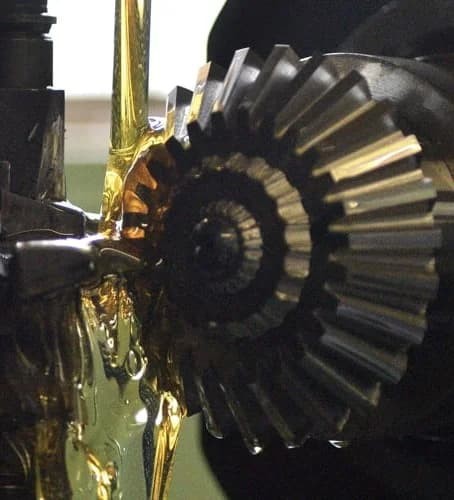
High lubrication demand | Sliding components require stable oil film | Lubrication management critical |
One of the most significant disadvantages is installation sensitivity. Even small deviations in mounting distance, shaft angle, or offset can change the tooth contact pattern, leading to localized stress concentration and premature wear.
Furthermore, spiral bevel and hypoid gears generate axial forces due to their geometry. These forces must be properly supported by bearing systems, increasing design complexity and cost.
5. Comparing different types of bevel gears
5.1 Straight Bevel Gear
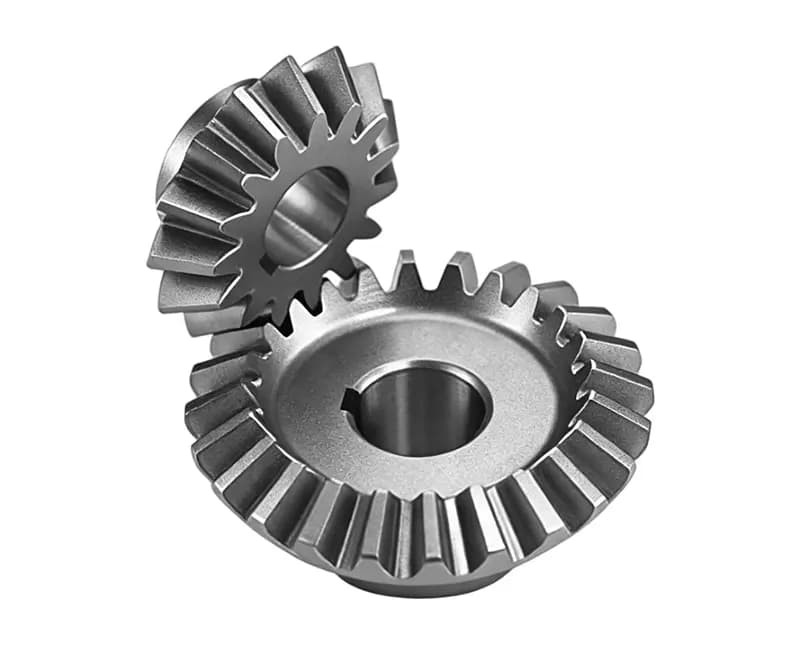
Straight bevel gears feature straight tooth traces that converge toward the apex of the cone.
Advantages
● Simple structure and mature manufacturing process
● Lower production cost
● Minimal axial force generation
Disadvantages
● Point-contact engagement results in lower load capacity
● Higher vibration and noise at increased speeds
● Less suitable for heavy-duty high-speed systems
Straight bevel gears are often selected for moderate-load applications where cost efficiency is prioritized over maximum load capacity.
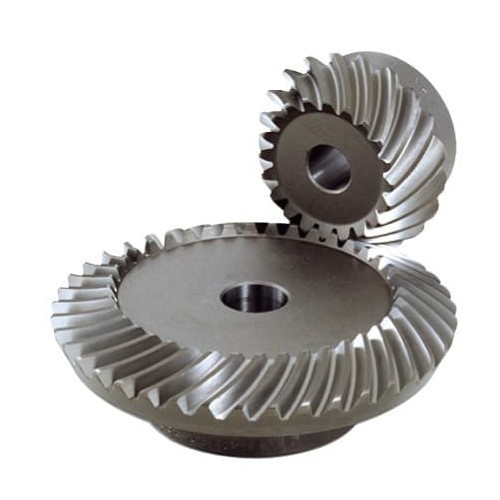
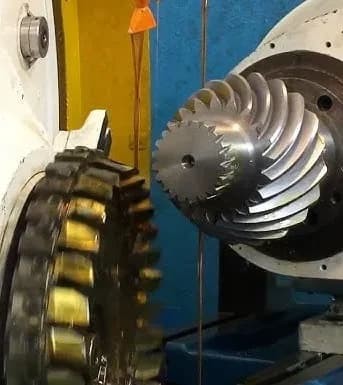
5.2 Spiral Bevel Gear
Spiral bevel gears have curved tooth traces, allowing gradual tooth engagement.
Advantages
● Smoother meshing with reduced impact
● Line contact increases load capacity
● Better stability at high rotational speeds
Disadvantages
● Generates considerable axial force
● Requires matched pair manufacturing
● Higher machining and inspection complexity
Spiral bevel gears are widely used in automotive differentials and heavy-duty gearboxes because of their balance between efficiency, durability, and noise performance.
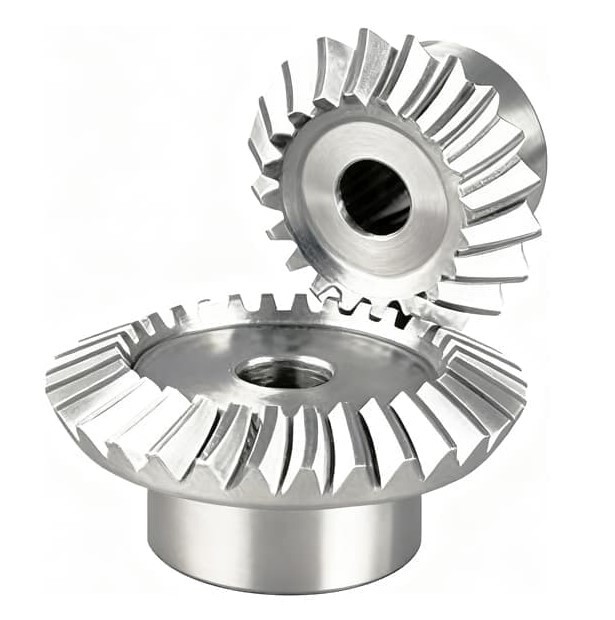
5.3 Zerol Bevel Gear
Zerol bevel gears have a curved tooth profile but a mean spiral angle close to zero.
Advantages
● Reduced axial force compared to spiral bevel gears
● Improved smoothness over straight bevel gears
● Moderate load capacity
Disadvantages
● More complex manufacturing than straight bevel gears
● Not ideal for extreme heavy-duty applications
Zerol gears are often considered a transitional design between straight and spiral bevel gears.
5.4 Hypoid Gear
Hypoid gears use offset axes, meaning the shafts do not intersect.
Advantages
● Longer contact line improves load capacity
● Wider ratio range (up to ~10:1)
● Allows lower mounting position in vehicle applications
● Supports compact structural arrangements
Disadvantages
● High sliding motion increases friction heat
● Extremely demanding lubrication conditions
● Strict alignment and offset tolerance requirements
● Higher axial forces compared to spiral bevel gears
Hypoid gears are commonly used in rear axle differential systems of heavy-duty vehicles due to their high torque capacity and packaging advantages.
6. Benefits of choosing the right bevel gear
| Benefit | Why It Matters |
Balanced load distribution | Prevents premature tooth failure |
Controlled axial force | Protects bearing systems |
| Optimized lubrication behavior | Improves durability |
| Stable torque transmission | Reduces vibration and noise |
| Predictable maintenance planning | Lowers lifecycle cost |
Selecting the correct bevel gear type reduces engineering risk. The "best" solution is not always the highest load-capacity design, but the one that controls the primary system constraint — whether it is packaging height, lubrication management, or bearing load.
7. Where bevel gears are typically used
Bevel gears are widely applied in:
● Agricultural machinery transmission systems
● Heavy-duty truck differential assemblies
● Construction equipment gearboxes
● EV reduction units
In agricultural machinery, bevel gears often operate under fluctuating loads and contaminated environments. In truck differentials, they must endure continuous torque transmission under variable road conditions. In EV drivetrains, compact packaging and efficiency are key selection factors.
8. Design considerations in heavy-duty systems
When evaluating bevel gears for demanding conditions, engineers should assess:
● Torque range and overload frequency
● Speed level and noise requirements
● Lubrication system reliability
● Bearing support structure for axial force
● Housing rigidity and alignment control
● Maintenance accessibility
In many cases, bevel gear performance depends more on installation control and lubrication management than on nominal geometry alone. A well-designed spiral bevel gear can fail prematurely if alignment is unstable, while a properly installed straight bevel gear can perform reliably within its design limits.
9. How to Select a Reliable Bevel Gear Supplier
Selecting a bevel gear supplier for heavy-duty applications requires evaluating technical capability rather than price alone. Because bevel gears are sensitive to geometry accuracy and installation conditions, supplier quality directly impacts system durability.
When reviewing potential suppliers, consider:
9.1Engineering support
The supplier should review drawings, confirm load conditions, and evaluate manufacturability before production.
9.2 Manufacturing precision
Spiral and hypoid gears require strict geometry control and matched-pair consistency. Ask about machining equipment and inspection methods.
9.3 Quality verification process
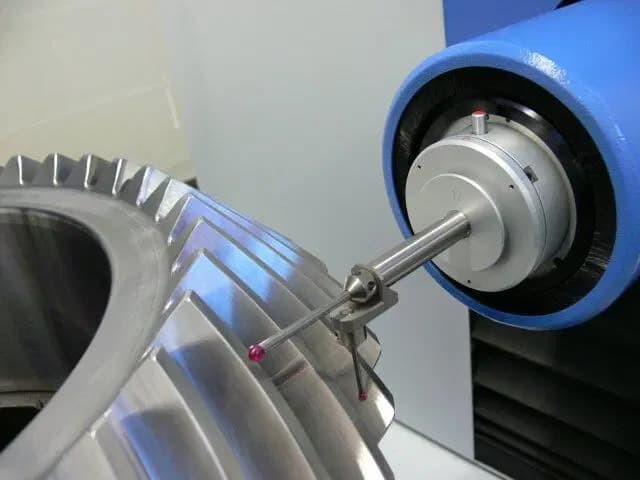
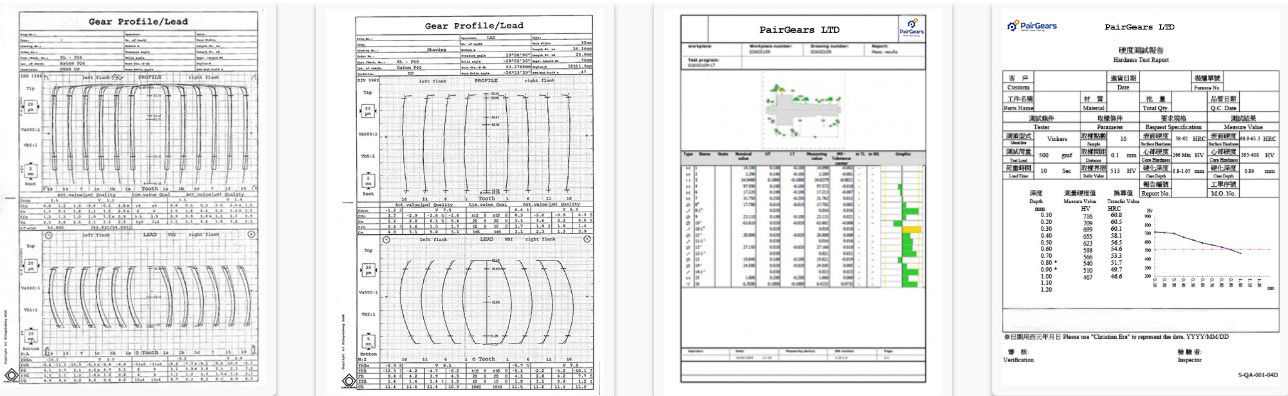
Contact pattern inspection, runout control, hardness testing, and dimensional measurement should be standardized and documented.
9.4 Experience in heavy-duty applications
Suppliers familiar with truck, agricultural, or industrial gearboxes better understand axial force and lubrication challenges.
9.5 Prototype and batch capability
The ability to support both small-batch validation and stable mass production reduces development risk.
A technically capable supplier improves installation reliability and reduces long-term maintenance uncertainty.
10. Why choose PairGears
PairGears supports custom bevel gear development for heavy-duty applications across agricultural machinery, truck transmissions, construction equipment, and industrial drivetrains. Our approach focuses on practical engineering evaluation and controlled manufacturing execution.
We provide:
10.1 Engineering evaluation before production
Drawing review, load assessment, and geometry feasibility analysis to reduce development risk.
10.2 Controlled manufacturing repeatability
Stable machining processes with consistent tooth geometry control to ensure matched-pair accuracy.
10.3 Strict inspection and quality verification
Tooth contact inspection, dimensional measurement, and hardness control to maintain batch stability.
10.4 Support from prototype to batch production
Flexible sample validation combined with reliable mass production capability.
10.5 Risk-focused design review
Consideration of axial force management, lubrication behavior, and installation constraints during early-stage evaluation.
We emphasize manufacturability, installation feasibility, and long-term reliability under real operating conditions rather than theoretical performance metrics alone. Our goal is to deliver bevel gears that integrate smoothly into your transmission system and perform consistently throughout their service life.
11. FAQ
Q1:What is the main advantage of bevel gears?
Their ability to transmit torque between intersecting shafts while changing direction.
Q2:What is the main limitation?
Higher manufacturing complexity and installation sensitivity.
Q3:Why do spiral bevel gears cost more?
They require precise geometry control, generate axial forces, and must operate as matched pairs.
Q4:When are hypoid gears preferred?
When higher torque capacity, compact packaging, and wider ratio range are required.
Q5:Can bevel gears replace spur gears?
Only when directional transmission between intersecting shafts is necessary.
12. Conclusion
Bevel gears provide an effective solution for directional transmission in compact mechanical systems, especially in heavy-duty applications. Their structural advantages must be balanced against manufacturing complexity, lubrication demands, and installation accuracy requirements.
If you are developing gear systems for Agricultural Machinery, Heavy-Duty Trucks, Construction Equipment, or EV drivetrains, Contact Us with your drawing or sample. PairGears can help evaluate the most practical bevel gear configuration for stable and repeatable production.